Albert Einstein Quotes
Perhaps I did use such philosophy earlier, and also wrote it, but it is nonsense all the same.
This quotation illustrates a major difference between scientists and politicians. When a politician changes a major position, he/she tends to feel obligated to explain or apologize as if he/she might have done something wrong. An explanation is certainly required. This contrasts with the scientist who has a change of mind. He/she just states it and moves on. If data changes and more is learned all scientists expect views to change, and the progress of science can be measured by the number of these changes. For a similar view from the political world, consider {619441} .
Albert Einstein, 1879-1955, Nobel laureate in Physics, Response when accused of flip-flopping from his earlier approach, Argument with Werner Heisenberg, Quoted in Palle Yourgrau, A World Without Time: The Forgotten Legacy of Godel and Einstein, 2005
Sourced by: Eigen's Political and Historical Quotations

See {627632} for an earlier advocy of change when circumstances warrant and {636175} for a modern view.


Most politicians would never do this. Ideologues rarely analyze their beliefs. Pragmatic politicians are fearful of being called a flip flopper with no core principles. However, some politicians follow this advice. For example, Abraham Lincoln and Franklin Delano Roosevelt were both among the rare politicians who would frequently change positions as they learned more. See John Maynard Keynes {619441} for a personal statement of this principle and {636175} for a modern view.


When a scientist is persuaded to change his position, he is acting in the great tradition of the best of scientists. When a politician does the same, he is a flip flopper, without any real principles and clearly not to be trusted. A scientist would not be trusted by his peers if he did not readily change is views.


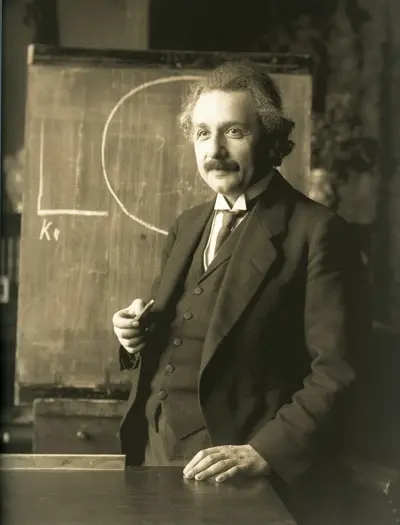
- Born: March 14, 1879
- Died: April 18, 1955
- Nationality: German, Swiss, American
- Profession: Physicist
Albert Einstein was a German-born theoretical physicist, widely acknowledged to be one of the greatest physicists of all time. Einstein is known for developing the theory of relativity, but he also made important contributions to the development of the theory of quantum mechanics. Relativity and quantum mechanics are together the two pillars of modern physics. His mass–energy equivalence formula E = mc2, which arises from relativity theory, has been dubbed "the world's most famous equation". His work is also known for its influence on the philosophy of science. He received the 1921 Nobel Prize in Physics "for his services to theoretical physics, and especially for his discovery of the law of the photoelectric effect", a pivotal step in the development of quantum theory. His intellectual achievements and originality resulted in "Einstein" becoming synonymous with "genius".
