Enrico Berlinguer Quotes
Over there, in the East [Eastern Europe & Russia] they would … like to see us build socialism as they like it. But over here, in the West, some people don’t even want to let us start building it, even if we do so respecting freedom. I realize that this is a little risky on our part to pursue a road that is not always appreciated either over here or over there.
The Italian Communists were culturally and ideologically very different from the Russian Communists. The Italian view was a more nationalistic one and was closer to a Socialist Democracy than a “dictatorship of the proletariat”. Much more tolerant of diversity and not as ideological. See {637829} as a big example of the difference. Yet this was still in the midst of the Red Scare in America and some other areas of the West. After WWII, the CIA had secretly spent millions to get Italians to vote for the non-Communist candidates and helped organize Italian anti-Communist politicians who didn’t want the Communists to alter the Italian government to reflect any Communist or Socialist ideas. Meanwhile, the Italian party was under great pressure from Russia and some of the other Communist satellite countries to adopt a hardline revolutionary communist programs. Berlinquer and other Italian Communist leaders had many misgivings about Russian style Communism and they had to play off one side against the other for years.
Enrico Berlinguer, 1922–1984, National secretary of the Italian Communist Party, Speech, 40th Communist Party Congress, March 23, 1975
Sourced by: Eigen's Political and Historical Quotations

The Italian Communists were culturally and ideologically very different from the Russian Communists. The Italian view was a more nationalistic one and was closer to a Socialist Democracy than a “dictatorship of the proletariat”. Much more tolerant of diversity and not as ideological. Berlinguer and some of the other leaders realized that Italy was always in danger of a Russian takeover since there was such a difference in views about Communism. They had seen how the Red Army had become a political enforcement vehicle and they had been leaders of the fight to unseat Mussolini and wanted to avoid totalitarianism. They understood that NATO with its forces and nuclear umbrella was the only force that could keep Italy free of the Russians decided to move. This is one of the reasons why the Italian Communist Party was not banned in Italy.


Some on the extreme left of the Labor Party at the time were extolling Soviet Russia while denigrating the United States. Crossman, an avid socialist thought that was absurd and said so at every opportunity. The pro Soviet wing of the Labour party got smaller and smaller. He and many others thought that Russian Communism was a very poor implementation of socialist ideas.

The letter was widely published. There were few left wing intellectuals who would take Lenin on at the time but Gorter was one. The immediate quotation shredded a brochure that Lenin had produced for world wide communism where he was critical of other left wing movements.

Vladimir Lenin

Ironically, at the time she wrote this column, Mrs. Roosevelt was being accused of being a communist by some Southerners who associated her strong views against racism and segregation. Some in the North thought she was a communist because of her active role in the New Deal, Yet here she was, willing to use military force to prevent Soviet expansion.


Every sect of Russian communism had an offshoot in America and in other countries as well. When bad blood broke out between sects in Russia, the battle spread to the rest of the world as when Leon Trotsky was assassinated by Stalinists in Mexico and the Trotskyites were viciously and physically attacked here in America. In many cases there was little ideological difference but the split reflected different leadership styles and personalities. Despite Frank’s warning, American communism was a mirror reflection of Russia until Stalin negotiated the WWII pact with Hitler, when anti-Stalin Communists began to be active, and because America was a more open society, American communists were ahead of their Russian comrades in denouncing Stalinism.

The 40 Committee was a secret committee of officials to deal with major national security covert operations possibilities. Chile had democratically elected Salvador Allende, a strong socialist, as President. He then, as he had promised in his campaign, begun to nationalize mining and other heavy industry and nationalized the very large farms. Kissinger and some others thought that Allende might probably transform Chile to communist state. The committee was discussing whether or not the United States should, via covert operations, try and destabilize or overthrow the Allende government. There was a strong minority aristocracy of the wealthy who would definitely support such an activity. Kissinger argued for intervention and some others observed that Allende had been fairly elected as a leftist by the people. Kissinger made this famous statement, and America covertly though the CIA worked with the Chilean right wing and fascists to overthrow Allende. The military, having been given the “green light” started attacking the Presidential Palace. Allende made a radio speech to the nation. A few hours later, the military seized the palace and reported that Allende had committed suicide.
Kissinger stating that the US should “correct” the election “mistakes” of other countries was of course Top Secret and the official US position was to support the right of any people to elect their preferred leaders. Normally, the public would never have seen the transcript of the meeting until many decades had passed but part of the transcript found their way to a manuscript of a book about the CIA. That agency went to the courts to block the publication and Kissinger’s statement. However, although the quote was removed from the book, enough people had now seen it, and the quote was leaked.
The quote is historically important for the real story of what really happened in Chile as General Pinochet who seized power turned out to be guilty of Crimes Against Humanity and Allende is today a national hero and martyr. In addition, it is a wonderful example of “overclassification”. After the action was completed, why should the American Public not know that its Secretary of State did not believe in democratic elections if the people would elect communists? --especially when the official stated policy he was presenting was just the opposite. The argument faded when the Watergate Scandal broke and consumed America’s attention.


After the 1917 Russian Revolution many of the Western Countries sent troops to Russia where they aided the Whites against the Reds. When the Red Bolsheviks prevailed, there were many attempts to diplomatically and economically undermine the Communist government. This caused a unity among different Russian factions. Sforza urged leaving them alone and letting the Bolsheviks fail by their own ideology. Most Western nations and the United States did not agree with him.

Like many in the 1920s, Dewar saw the Communist Soviet Union as the biggest potential risk to peace. However, although the Russian leaders constantly castigated the West, they did not have a large military, and were for the most part highly anti-war as they saw war as the product of Capitalistic competition and the tool of the aristocracy. They had little military equipment and almost no training or officer corps with which to build any Army. Germany in contrast had the skill, experience, officers, a history of aggression, and huge resentment over what they considered their humiliating WWI defeat and peace terms. They would start WWII, not Russia.


This is a very important historical, political quotation. The conservatives have since the Russian Revolution conflated socialism and communism. However, here in 1932 the leader of the American Socialist Party had already described the Communist Revolution in Russia as a failure of founding an acceptable modern state. Nonetheless, even into the 21st century many conservatives describe Thomas as a Communist. See {626692} for his distinction between Communism and Socialism. The difficulty of modern nation building was explained by Thomas and others but was really not accepted until the many attempts of the early 21st century, some supported by America like Iraq and Afghanistan and the Balkans and others like the “Arab Spring.” Then his early wisdom on this point became more appreciated.
This was a big factor that made the Red Scare so damaging.

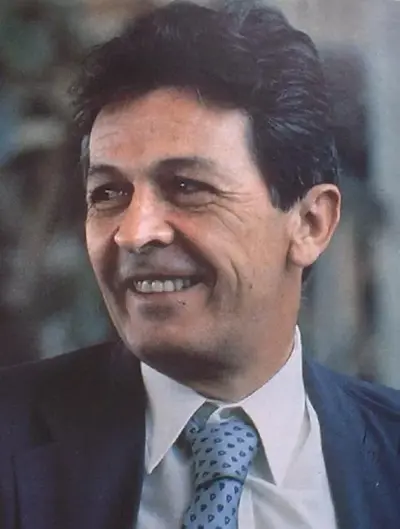
- Born: May 25, 1922
- Died: June 11, 1984
- Nationality: Italian
- Profession:
Enrico Berlinguer was an Italian politician, considered the most popular leader of the Italian Communist Party (PCI), which he led as the national secretary from 1972 until his death during a tense period in Italy's history, marked by the Years of lead and social conflicts such as the Hot Autumn of 1969–1970.
