John England Quotes
Our federal government is not warranted to intermeddle with the interests of religion, directly or indirectly. It is not commissioned to take any part whatever in religious concerns.
At the time. Catholics in America were proportionately many fewer than today, and anti-Catholic sentiment and discrimination was very common. If the government then could become involved with religion, the protestant-dominated government would likely have restricted the Church and Catholics. So Catholics were, like Bishop England an absolutist for the separation of church and state. However towards the end of the 20th century, Roman Catholics were about 25% of the population and anti-Catholic sentiment was reduced to relatively few Protest extremists, who were rejected by the main stream even of Protestants. Then the Catholic bishops began to change their position and advocated Federal aid to parochial schools and various Catholic social services. They also began to lobby government to make laws enforcing the Catholic views of morality.
John England, 1786-1842, First Catholic Bishop of Charleston, SC, Letter, September 26, 1831
Sourced by: Eigen's Political and Historical Quotations


This is one of the key documents showing the “wall of separation of church and state” was in use in early America. Almost 200 years later the Chief Justice of the Supreme Court seemed ignorant of this communications. See William Rehnquist: {373663}


Carter was personally one of the most religious of our Presidents.


This is a critical quotation on the government establishment of religion issue. There are a few people who have argued over the years that the Founding Fathers and their culture was religious and where they were careful to avoid favoring one religion over another, they did NOT intend to put atheism on the same equal plane as religion as far as government action is concerned. However, some of the Founding Fathers were atheists, and some others like John Adams were deists—they believed in a God but not in the Trinity or in Judaism or any organized religion. So this quotation makes it clear that the First Amendment does NOT favor religion over non religion or secularism. Atheism must be on an equal footing but not on a higher plane.


While this principle is very clear to us today, and was to the people who originally ratified The Constitution, there were many attempts by Christian groups to establish a privileged position for Christianity. For example, for years the Sunday Sabbath was legally enforced by unconstitutional Blue Laws that prohibited businesses from operating on the Christian Sabbath and prohibited activities that compete with Sunday church attendance. Supreme Court Justice Story even argued that the First Amendment allowed Christian religious supremacy and Cooley wrote this to refute Story’s now discredited doctrine.


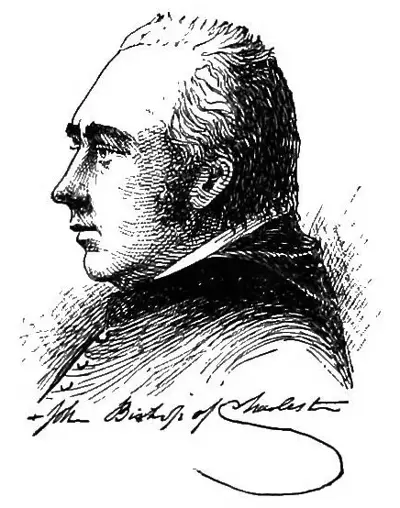
John England was the first Roman Catholic Bishop of Charleston, South Carolina. England served as a priest in Cork, where, before being appointed to Charleston, he was very active in the movement for Catholic Emancipation.
