Jonathan Turley Quotes
Obama is as likely to be impeached as he is to be installed as the next pontiff. And I say that as someone who has testified in Congress that this president has violated federal laws, unconstitutionally appointed various executive-branch officers and improperly transferred money.
Turley, Jonathan. "Why Obama Shouldn't Be Impeached." The Washington Post, WP Company, 25 July 2014.


When the Senate was debating the Gulf of Tonkin Resolution, which would empower the President to take "all necessary measures" to repel any armed attack on U. S. forces, Senator Morse was one of only two Senators opposing the resolution:

The issue had first arisen during the Watergate Scandal, where there was concern that if the House held impeachment hearings of President Nixon, he might refuse to provide documents or order others in the Executive Branch not to testify. In this hearing, they were discussing the possible impeachment of President George W. Bush.


From this quotation, {624648} and {615902} it is clear that the framers of the Constitution intended the treaty making powers to be shared by the President and the Senate. In practice, in modern times treaties are usually initially negotiated by diplomats under the supervision of the President and the Senate gets to concur or not in the ratification process. However, there have been a number of treaty failures including the League of Nations where the lack of coordination has resulted in a situation where the Senate had to accept or reject something which the President had negotiated and the Senate rejected the treaty.


The Mexican War was as controversial as any war in American History. President Polk ordered action independent of the Congress, In all of American History there have been two Congressional censures of American Presidents. This was one. See {594521} for the other.

Alberto Gonzalez, White House Counsel and later Attorney General who was forced to resign and David S. Addington, Counsel to the Vice President, had come up with a novel view of the powers of the presidency. They argued that since the President is the Commander in Chief, in a war situation or intelligence gathering thereto, has the Constitutional responsibility for that function, he need not obey any laws of Congress as in the conduct of the war Congress would be impinging on the Constitutional separation of powers which itself was prohibited by the Constitution. The argument did not find any significant legal support but for a while the George W. Bush White House behaved as if this were the law, despite the fact that even in the American Revolution and the War of 1812 Congress passed laws regulating the conduct of the armed forces as is provided for in other parts of the Constitution. Yet even Goldsmith would allow the President some powers that many think are unconstitutional and/or belong to Congress. See {32436}.


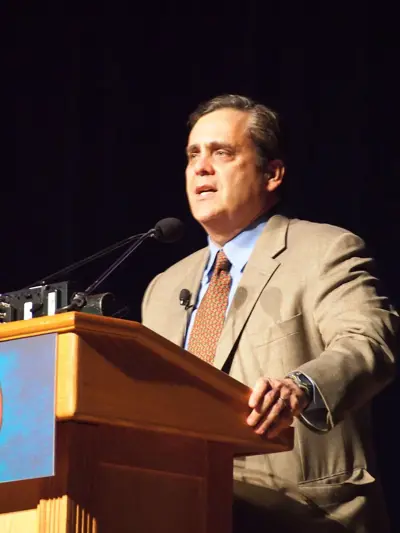
Jonathan Turley is an American attorney, legal scholar, writer, commentator, and legal analyst in broadcast and print journalism. A professor at George Washington University Law School, he has testified in United States Congressional proceedings about constitutional and statutory issues. He participated in House of Representatives impeachment hearings and Senate removal trials, including the impeachment of President Bill Clinton and the impeachment inquiry of President Donald Trump.
