Arthur A. Fletcher Quotes
Normally it takes us 8 years to get rid of 10 thousand copies of one of our reports.
Arthur A. Fletcher, Chairman, U. S. Commission on Civil Rights, Speech, The Police Foundation, April 6, 1993
Sourced by: Eigen's Political and Historical Quotations

The Tea Party movement began as a ultra conservative / libertarian off shoot from the right wing of the Republican Party. However, it was really a loose amalgam of disparate groups and individuals. While some of the Tea Party enthusiasts were genuine conservatives and/or libertarians who were not racist and fascist, the fascist and racist elements of the nations—the extremists—were also attracted to the new movement would depart from the Republicans who they thought were too liberal and political. Williams and others rapidly exposed themselves and the hateful elements of the Tea Party.


The businessmen of Atlanta were concerned that the hatred and conflict over race that was so prevalent across the South was harming business in that many people avoided coming to Southern communities for fear of the violence. Others boycotted Southern Cities that had discriminatory policies. Atlanta, tried to create both a different reality and image, and succeeded somewhat at both.


Jessie Helms was his young assistant who drafted this race baiting ad. There are two vicious but subtle aspects to this kind of attach ads. First, not that the ad does not address the problem of white men working along side of blacks. It only refers to wives and daughter. This interracial sex innuendo played on and increased the fear of whites that Blacks would commonly rape white women. The second nasty aspect of the ad is the specific attack on the opponent. Instead of saying that he favored desegregation, the phrase “mingling of the races” was used which implied that Graham was in favor of biracial intermarriage and children—again another sex innuendo. When integration of the workforce finally occurred in the South, there was no increase in Black men sexually assaulting white women. There has been a substantial increase in racial intermarriage however as racial bigotry has diminished in America.

Wilson, a history and government professor and college president before politics, was has been accused of being one of the most racist Presidents since Reconstruction. Prior to his Presidency, the Federal Government had been making steady progress in hiring African Americans. Under Wilson there was a wholesale firing of a large proportion of them. Some apologists argue that his League of Nations and other major aspirations required the votes and cooperation of Southern Senators who insisted that many of the blacks be terminated. At the same time, the KKK was near the zenith of its membership and political power and was an intimidating force. Wilson’s home state of New Jersey not only had a large KKK membership but there were lynching of Blacks in his own state and when Governor and President he never asked for any anti-lynching legislation.


Reconstruction was the period in the South after the Civil War. The change that emancipation brought to the white South was traumatic, and there was a constant struggle between those who wanted the Blacks to be integrated into Southern Society—and those Southerners who wanted to create a society that would be as close to slavery as possible, So the Klu Klux Klan and other terrorist organizations formed and with lynching and other intimidation, much of the initial progress of Reconstruction was rolled back and did not get reinstated until the Civil Rights and Voting Rights Acts were passed in 1964.


At the time, the Southern segregationists were all Democrats and they blocked any Democratic attempt to pass any Civil Rights legislation. When he could not get a Civil Rights commitment from his own party, Powell turned to the Republicans and the President wrote this letter. In return, in November, Powell endorsed and supported Eisenhower instead of Stevenson, his own party’s nominee. Eisenhower could not get any legislation on Civil Rights as the Southern Democrats would always block it. When President Lyndon Johnson finally forced the 1963 Civil Rights Act through the Congress, the racist Southern Democrats cut a deal with Goldwater and the conservative Republicans, and switched parties. Since then the Civil Rights stance of the two parties reversed. The Democrats were thereafter pro Civil Rights and the Republicans, the party of Lincoln and Reconstruction, thereafter reversed their Civil Rights position and opposed progress in this area.


In that year he resigned from the War Department in protest of the discrimination and racism in the armed forces.


This widely publicized statement by Mr. Ethridge was made when he was a member of the President's Committee on Fair Employment Practices during the hearings of this Committee at Birmingham, Alabama.


Blacks were fighting and dying in WWII. They were equal when they were under fire, but otherwise not. The war was against fascist protagonists whose creed was inequality while the allies were upholding freedom and equality. But making that aspiration a reality was difficult.
This marvelous quotation gives us a picture of the essence of the conflict in conception of freedom between Southern whites and negroes. There was no way to change the large majority of whites’ opinions and it is easy to see why Jim Crow and Southern discrimination evolved as it did. The emancipated Blacks had insufficient power or resources and there was not enough effort or success at changing white attitudes and no where near enough law enforcement to impose the view on the majority of the Southern white population.
Indeed, he was wrong in the sense that the Southern whites did NOT even obey the letter of the law. The Klu Klux Klan and the rest of Southern Jim Crow terrorism broke the laws of the states and local communities as well as Federal law but they did so with impunity. Andrews recognized the problem but never suspected that it would be as bad as it got with public torture and lynching commonplace and approved by most white Southerners.
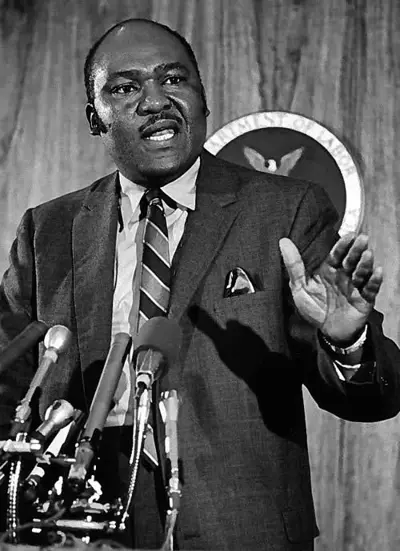
Arthur Allen Fletcher was an American government official, widely referred to as the "father of affirmative action" as he was largely responsible for the Revised Philadelphia Plan.
