Atlanta Quotes
The City Too Busy To Hate
The businessmen of Atlanta were concerned that the hatred and conflict over race that was so prevalent across the South was harming business in that many people avoided coming to Southern communities for fear of the violence. Others boycotted Southern Cities that had discriminatory policies. Atlanta, tried to create both a different reality and image, and succeeded somewhat at both.
Atlanta, Georgia, Motto Adopted during the Civil Rights movement of the 1960s
Sourced by: Eigen's Political and Historical Quotations

Reconstruction was the period in the South after the Civil War. The change that emancipation brought to the white South was traumatic, and there was a constant struggle between those who wanted the Blacks to be integrated into Southern Society—and those Southerners who wanted to create a society that would be as close to slavery as possible, So the Klu Klux Klan and other terrorist organizations formed and with lynching and other intimidation, much of the initial progress of Reconstruction was rolled back and did not get reinstated until the Civil Rights and Voting Rights Acts were passed in 1964.


The statement was made even more dramatic as the outgoing Governor, Lester Mattox, standing behind Carter at the ceremony, was an arch segregationist.


He was right. Even the vaunted Southern Filibuster was broken by the strategy and tactics Johnson and Senator Humbert Humphry, the Floor Leader for the 1964 Civil Rights Bill.

This was art of the Nixon "Southern Strategy" to alienate the white supremacists and racists from the Democratic Party with Civil Rights legislation and rhetoric, and get most of them to become Republicans. But as Phillips observed, when Negroes began voting in significant numbers in the South the party switching really accelerated.


What America just could not believe that American Negroes were not satisfied with their second class status. So any organized Negro unrest must be caused by un-American and foreign influences or those of radicals like Socialists. The Socialists were among the first organized political groups to condemn the racism and discrimination of the day. Later, even at the crux of the civil rights movement in the 1960s, most Southerners maintained that all the dissatisfaction and unrest of Negroes was the result of “agitators,” “foreigners,” “socialists,” and “communists.”


Defending his action of using national guard troops to prevent school integration:

It was used as a whipping boy and led to a re-alignment of Southern politicians to the Republican party.


Armstrong rarely commented on politics (see {615854}), but the Governor defying the Supreme Court and not letting his people even go to school with other students was too much for him. He not only made the statement, but he approved it for publication. This shocked many who knew him as an apolitical person. He was particularly distressed with President Eisenhower who although he had warned Faubus that he would enforce the court order and then used federal troops to do so, Eisenhower was a man of action and not rhetoric and his lack of firm public statements overlooked an opportunity to use the Presidential “bully pulpit” and exercise his moral leadership and authority. Many then, and even 50 years later, were not sure where he stood on the issue of school desegregation. See {615852}.


This widely publicized statement by Mr. Ethridge was made when he was a member of the President's Committee on Fair Employment Practices during the hearings of this Committee at Birmingham, Alabama.

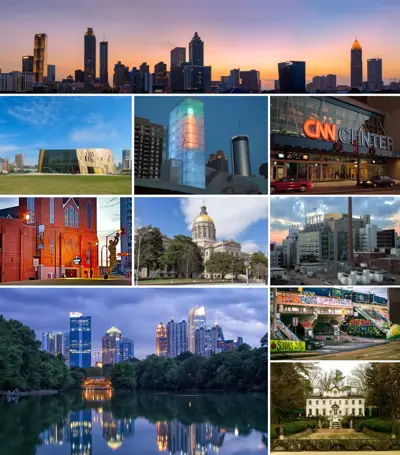
Atlanta (/ætˈlæntə/) is the capital and most populous city of the U.S. state of Georgia. With an estimated 2019 population of 506,811, it is also the 37th most populous city in the United States. The city serves as the cultural and economic center of the Atlanta metropolitan area, home to more than 6 million people and the ninth-largest metropolitan area in the nation. Atlanta is the seat of Fulton County, the most populous county in Georgia. Portions of the city extend eastward into neighboring DeKalb County. The city is situated among the foothills of the Appalachian Mountains and has the highest elevation among major cities east of the Mississippi River.
