Montesquieu Quotes
Nor is there liberty if the power of judging is not separated from legislative power and from executive power. If it [the power of judging] were joined to legislative power, the power over life and liberty of the citizens would be arbitrary, for the judge would be the legislature if it were joined to the executive power, the judge could have the force of an oppressor. All would be lost if the same … body of principal men … exercised these three powers
The drafters of the Constitution were well aware of this view of Montesquieu’s which was one of the main bases of separation of powers and checks and balances in America.
Charles de Montesquieu, 1689-1755, French Lawyer, Writer & Political Philosopher, 1748
Sourced by: Eigen's Political and Historical Quotations

Later quoted by Alexander Hamilton in the Federalist Papers


Hatch was the chairman of the Senate Judiciary Committee at the time.

This constitution was written 7 years before the national constitutional convention. It shows that there was concern about the separation of powers in United States even before the Constitution was drafted. See {616750} for an even clearer statement of the separation of powers principle.


Though not very dramatic or succinct, this is a very important quotation in American History. The original drafters of the Constitution concentrated on limiting the powers of the executive—the role of the King. But the Congress had no limits placed on them. In Britain, to this day, the Parliament can do whatever they wish as there is no restraint on them other than their prudence and reasonableness. Madison used the example of the Alien and Sedition Acts—huge infringements on the rights of Americans—to show why the legislative branch must also be more restrained and limited. And that was the logic behind adding the Bill of Rights to our Constitutions.


See Louis Brandeis for a later judicial interpretation of this view.

Vidal, a staunch liberal held this view along with many ultra conservatives end extreme liberals. The constitution requires the Congress to declare war, but they have not done so for any of the wars since WWII. The President assumed the war power. And the only coherent budgets began.


For Turgot, see below

The view that the Supreme Court was the final arbiter of constitutional controversies was not held in early America.


One of the conundrums of our constitutional system is who has the last word as to what the Constitution means. Essentially it is the judicial branch headed by the Supreme Court. But there are those who believe that the current popular majority should have a say in what is or is not constitutional. If so the legislative branch should have the last word. Still others say that the President is the only person elected by ALL the people, so his opinion most reflects the will of the public. And then there are most who argue that the Constitutional system was created just to avoid the power of currently popular majorities, and the courts should decide based on the Constitution itself. So the statement has very little meaning except that Phillips thinks that the courts have too much power. Whoever gets to decide what is or is not Constitutional will be accused of being “over” the Constitution by those who don’t like the decisions. In our system, that is the courts.


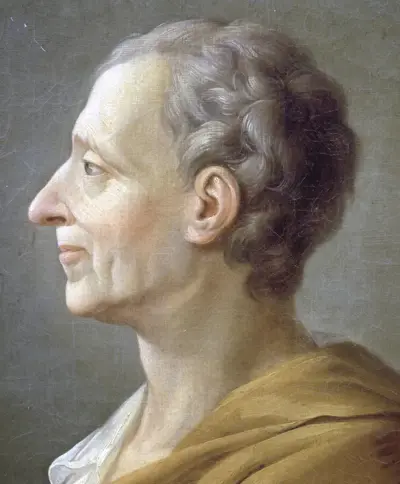
Charles-Louis de Secondat, Baron de La Brède et de Montesquieu, generally referred to as simply Montesquieu, was a French judge, man of letters, and political philosopher.
