Montesquieu Quotes
There is no liberty if the judiciary power be not separated from the legislative and executive. Were it joined with the legislative, the life and liberty of the subject would be exposed to arbitrary control; for the judge would then be the legislator. Were it joined to the executive power, the judge might behave with violence and oppression.
Later quoted by Alexander Hamilton in the Federalist Papers
Charles de Montesquieu, 1689-1755, French Lawyer, Writer & Political Philosopher, The Spirit of the Laws, 1748
Sourced by: Eigen's Political and Historical Quotations

The drafters of the Constitution were well aware of this view of Montesquieu’s which was one of the main bases of separation of powers and checks and balances in America.

This constitution was written 7 years before the national constitutional convention. It shows that there was concern about the separation of powers in United States even before the Constitution was drafted. See {616750} for an even clearer statement of the separation of powers principle.

Hatch was the chairman of the Senate Judiciary Committee at the time.


The highest court in New York.

Barstow the Democratic Governor who had no serious opposition in 1853 found himself challenged for reelection by Coles Bashford of the new Republican Party. The Board of Canvassers reported that Governor Barstow had won reelection but by less than 200 votes in the whole state. The Republicans charged that there had been fraud in some of the rural districts and petitioned the Wisconsin Supreme Court which ruled that nonexistent precincts had indeed voted for the Governor. The Barstow however refused to recognize the decisions of the court claiming that the court had no jurisdiction over the Board of Canvassers who were part of the executive branch. The Republicans held their own inauguration and two men claimed to be Governor. But the Governor claimed that the state constitution did not give the court any authority to deal with the crisis, He even called out the State Militia to maintain his office and intimidate the Supreme Court and keep the “other governor” from the state house. Nonetheless the court ruled that even the Governor had to obey the law and the Supreme Court would determine what the law was. Barstow finally “resigned.” See {587917} & {587914}.


Jefferson’s fears were later reinforced by John Marshall in Marbury v. Madison {606468}


The view that the Supreme Court was the final arbiter of constitutional controversies was not held in early America.


See John Marshall's later (1803) use of the concept and term "repugnant." {606483}


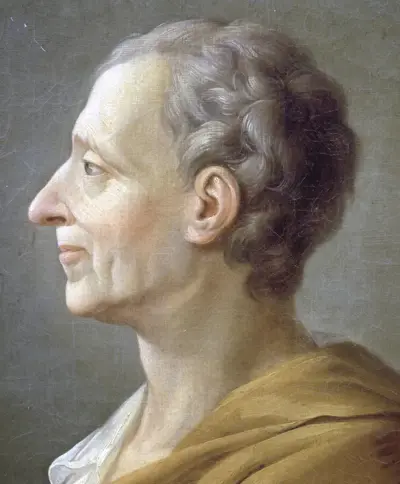
Charles-Louis de Secondat, Baron de La Brède et de Montesquieu, generally referred to as simply Montesquieu, was a French judge, man of letters, and political philosopher.
