John Jay Quotes
No power on earth has a right to take our property from us without our consent.
Jay, John. "Address to the People of Great Britain." The Correspondence and Public Papers of John Jay, edited by Henry P. Johnston, vol. 1, G. P. Putnam's Sons, 1890, p. 19.

He was considered Massachusetts’ greatest Colonial orator.


Some would say that the same two questions are still troubling the country.


The call for individual liberty and the right of personal property by clergy is surprising to many. This Cahier was the consensus of the Clergy of Blois in 1789. There were cahiers of several provinces of France—some by the clergy, some by the nobles. What is fascinating is the emergence of many of the pre-Revolutionary French concepts. The example of the American revolution and its principles was known throughout the educated classes of France.
What was to become the 14th Amendment was being discussed. Several of the most radical Republicans drafted language that would allow Congress to make any law regarding life, liberty or property, so that they could be sure that the States would not make their laws in a discriminatory manner. However, Hotchkiss and the majority wanted to be sure the laws were not discriminatory but they didn’t want Congress to have the power to make any law regarding life, liberty and property for every state. The current version of the 14th Amendment just prohibited discrimination in laws, not empowering the Federal Government to override the state governments in most important areas.

The people who raise the issue do not claim that property rights are not human rights. They do analyze different rights to priorities. For example, most people would view the right to life as more important than the right to travel. Unfortunately rights sometimes come into conflict. What Rand calls the “dichotomy” is the prioritizing of property fights as lower than some other rights such as the right to life. Those people would argue that a businessman should not have a facility that is a public hazard and interfere with his property rights to protect the lives of the public who might encounter the hazard.
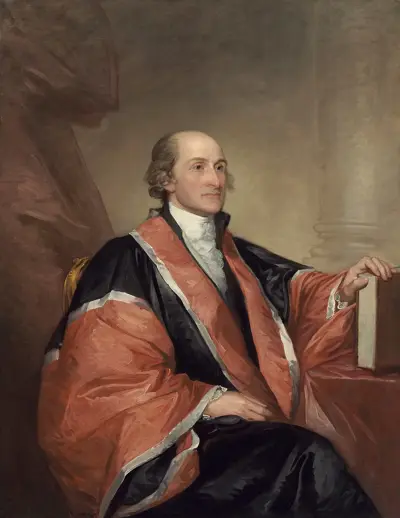
John Jay was an American statesman, patriot, diplomat, Founding Father, abolitionist, negotiator, and signatory of the Treaty of Paris of 1783. He served as the second Governor of New York and the first Chief Justice of the United States (1789–1795). He directed U.S. foreign policy for much of the 1780s and was an important leader of the Federalist Party after the ratification of the United States Constitution in 1788.
