Ayn Rand Quotes
… there is no such dichotomy as “human rights” versus “property rights.” No human rights can exist without property rights.
The people who raise the issue do not claim that property rights are not human rights. They do analyze different rights to priorities. For example, most people would view the right to life as more important than the right to travel. Unfortunately rights sometimes come into conflict. What Rand calls the “dichotomy” is the prioritizing of property fights as lower than some other rights such as the right to life. Those people would argue that a businessman should not have a facility that is a public hazard and interfere with his property rights to protect the lives of the public who might encounter the hazard.
Ayn Rand, 1905-1982, Writer & Philosopher, The Virtue of Selfishness, 1964
Sourced by: Eigen's Political and Historical Quotations


See {587703} for a similar statement by a Supreme Court Justice.


Jefferson and some of the other Founding Fathers saw the American experiment as having implications for the whole world. To Jefferson, the Declaration of Independence was not just for Americans but ideally for all mankind.

Hayward claimed that Wilson was the first American President who ever criticized the American Constitution. Many do not agree as Madison and Jefferson in part, along with most other Americans, found the Constitution so wanting that it was ratified only on condition of the passage of the Bill of Rights. Jackson, was distressed by the limitations on the President and many others had their objections, but Wilson, before he became a politician was a prominent academic political scientist and wrote voluminously and had an intellectual following so his criticism was not considered so “political” as others.


Note the use of the phrase “against the government.” One of the unique aspects of the American Constitution and The Bill of Rights is that the government is considered a potential and even probable infringer on the liberties of the people. It is almost as though the government was the potential enemy. Modern libertarians state this very explicitly and it is ever present in the views of both the right and left wings of American politics. Most centrists recoil at the thought that some citizens see the government as the enemy, but even in America there have been times where the government has infringed on the rights of citizens only to have the courts or future administrations and Congresses correct the error.

He had been a Congressman before assuming the Presidency. Civil rights was a major subject of debate after the Civil War. One major issue was that of citizenship itself. Many contended that Americans were citizens of a state and dependant on the state for the protection of civil rights. However, the extent to which the Federal government could and should be the guarantor of citizenship issues was in dispute. Today with the issue settled in favor of Federal preeminence, it is hard to realize that this was very unsettled at one point in history. Garfield was one of those leading the effort for more Federal involvement and control.

He was considered Massachusetts’ greatest Colonial orator.

The call for individual liberty and the right of personal property by clergy is surprising to many. This Cahier was the consensus of the Clergy of Blois in 1789. There were cahiers of several provinces of France—some by the clergy, some by the nobles. What is fascinating is the emergence of many of the pre-Revolutionary French concepts. The example of the American revolution and its principles was known throughout the educated classes of France.


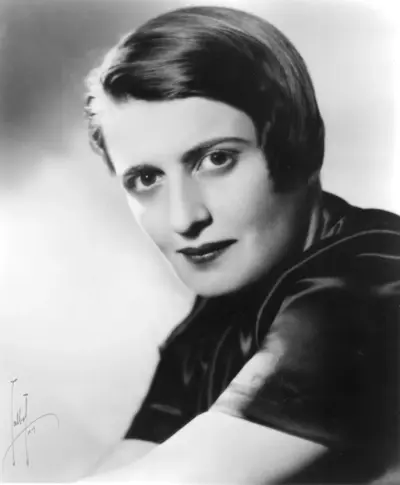
Ayn Rand was a Russian-American writer and philosopher. She is known for her two best-selling novels, The Fountainhead and Atlas Shrugged, and for developing a philosophical system she named Objectivism. Born and educated in Russia, she moved to the United States in 1926. She had a play produced on Broadway in 1935 and 1936. After two early novels that were initially unsuccessful, she achieved fame with her 1943 novel, The Fountainhead. In 1957, Rand published her best-known work, the novel Atlas Shrugged. Afterward, she turned to non-fiction to promote her philosophy, publishing her own periodicals and releasing several collections of essays until her death in 1982.
