Samuel Alito Quotes
No one is above the law; no one is beneath the law…. No person in America is above the law and that includes the President and the Supreme Court…. Neither the President or anybody else can override a law that is Constitutional.
Samuel Alito, Supreme Court Justice, Statement at his confirmation hearing January 9 & 10, 2006
Sourced by: Eigen's Political and Historical Quotations


This concept of balance of power and the equal role of the judiciary is actually quite rare. Even in Parliamentary democracies the parliament can override any court interpretation. In England, the upper legislative house, the House of Lords, actually serves as the nation’s highest or supreme court. And these “Law Lords” can override all regular judicial bodies.

See John Marshall's later (1803) use of the concept and term "repugnant." {606483}

This principle has been in force since the beginning of our republic. However, there was a suggested challenge to it by President Richard M. Nixon, and a substantial challenge by the George W. Bush Administration which took the position that as long as the President was engaged in carrying out a Constitutionally mandated function, like war or foreign policy, the President did not have to obey the existing laws and could direct his subordinates to violate the law. Bush lost in those areas which came to the courts and the Supreme Court made it clear that even the President, carry out his official duties, had no immunity from the laws of the nation.

Powell was the Secretary of State and Addington kept advising the administration that as long as the President was acting in defense of the country in his capacity as Commander in Chief, he did not have to obey any existing laws that had been Constitutionally passed which in the opinion of the President restricted or limited the President or the executive branch. Addington was an attorney and Assistant to the Vice President, but he was given much responsibility for administration policy. Powell the Secretary of State of the Administration could not have disagreed more and although most politicians including Republicans disagreed with the Addington thesis, Powell was one of the few Republicans to criticize the Addington position.


Katyl had represented Salim Ahmed Hamdan, a Yemeni suspected Islamic terrorist being held at Guantanamo who sued the Government over his detention without trial or due process and the Bush Administration’s Military Commissions. In Hamdan v. Rumsfeld, the Supreme Court ruled that the Government was violating Hamdan’s rights.

President George W. Bush had ignored a federal law and tapped the phones of Americans without probable cause and a warrant issued by a court. The President’s defenders argued that the President, as Commander in Chief, has the Constitutional responsibility to lead the military and protect the nation. Intelligence gathering is part of military activity. Therefore the intelligence gathering is a Constitutional duty and the Congress, under the separation of powers doctrine, may not interfere with the President’s Constitutional Duty to conduct intelligence. Under this doctrine, the President need not obey laws that he believes impinge on his management of the war effort and the defense of the nation. Most legal scholars believe that this argument is nonsense, but the George W. Bush administration has stated the doctrine and it was the subject of much litigation.

One of the conundrums of our constitutional system is who has the last word as to what the Constitution means. Essentially it is the judicial branch headed by the Supreme Court. But there are those who believe that the current popular majority should have a say in what is or is not constitutional. If so the legislative branch should have the last word. Still others say that the President is the only person elected by ALL the people, so his opinion most reflects the will of the public. And then there are most who argue that the Constitutional system was created just to avoid the power of currently popular majorities, and the courts should decide based on the Constitution itself. So the statement has very little meaning except that Phillips thinks that the courts have too much power. Whoever gets to decide what is or is not Constitutional will be accused of being “over” the Constitution by those who don’t like the decisions. In our system, that is the courts.


The Congress over the last century has ceded much of its Constitutional power to the President. Congress has much power to check the President, but just as Congress has not been very competent at legislating, oversight, and conducting hearings and investigations, it has not organized itself to use the powers it has very well.

In the 2000 Presidential Election, Gore won the popular vote, but the electoral votes were so close that the winner depended on a single state, Florida. However, that state’s election process was poor and there were many irregularities and problems in vote counting and recounting. The Republican Secretary of State stated that the Republican candidate won, but the irregularities persuaded the Florida Supreme Court to order a recount. That decision was appealed to the Supreme Court which decided to stop the recount, giving the Presidency to Bush. All nine Supreme Court Justices were unhappy that they had to decide a case which determined who the President would be, but if they had refused to hear the case, the raw politics of Florida would determine the President. Stevens wrote this quotation in his dissent, and ironically it was about the only thing that the nine justices all agreed to—that the nation’s confidence in the Supreme Court and the legal system was the loser. There was no way for the court to win, unless they could have mustered an overwhelming majority for one side or the other. That proved impossible, so all the justices tried to make the best of a bad situation in which they had been placed.


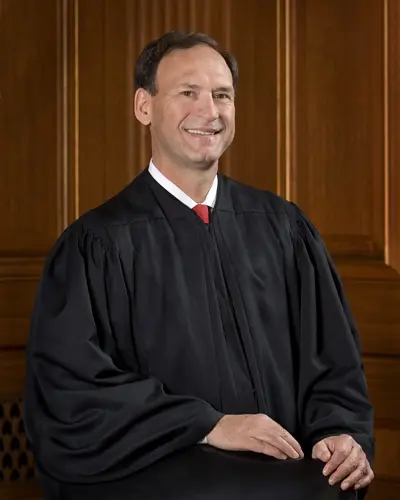
Samuel Anthony Alito Jr. is an associate justice of the Supreme Court of the United States. He was nominated by President George W. Bush on October 31, 2005, and has served since January 31, 2006. He is the second Italian-American justice to serve on the Supreme Court, after Antonin Scalia, and the eleventh Roman Catholic.
