Susan B. Anthony Quotes
No compromise with slave holders!
Susan B. Anthony, 1820-1906, Woman's Suffrage Leader, Frequent slogan in her abolitionism speaking tours
Sourced by: Eigen's Political and Historical Quotations


The Federal Fugitive Slave Act required all in free states to assist owners of escaped slaves to return them to their owners. In 1854 a Missouri slave owner tracked his escaped slave to Wisconsin and the Federal officials incarcerated the slave pending his return. A Wisconsin mob broke the slave out of jail and helped him escape to Canada. Booth was convicted under the Fugitive Slave Act for aiding the escape. Booth’s conviction was overturned by Wisconsin Supreme Court Judge Smith whose opinion overturned the Fugitive Slave Act on the grounds that it had usurped state’s rights. The Supreme Court overturned Smith’s ruling, but Booth was pardoned. See {587928}, {587927} & {587928}. State’s rights is a concept that we generally identify with Southern slave holding states to maintain slavery, but in this case, Wisconsin used the concept to fight slavery.

The Mystery was for many years the only Black Newspaper in America.

Fitzhugh was a Southern iconoclast whose view of Northern labor was much like that of Karl Marx but who was an enthusiastic supporter of slavery. Fitzhugh was of the opinion that slavery would be reinstated in the North and his treatise agues for that. More and more intellectual opinion was coming to the conclusion that slavery must be abolished or made universal before Lincoln’s famous statement in his debate against Douglas. Although Northerners and Southerners had come to agree on this point, they disagreed about which alternative would and should prevail.

The cause of the Civil War was slavery. When the Souh fired on the nation’s army and governmental personal, the secession became treason. So Slavery was the cause of the treason. Douglass argued that if we eliminate slavery, we eliminate the cause of the Treason.


While England was strongly opposed to slavery, the English textile industry benefited from importing American Southern cotton. So many in England were supportive of the Confederacy.


The National Enquirer was originally a serious abolitionist newspaper, not the sensationalist tabloid it became in modern times.


Lincoln had promised amnesty to Southerners who would pledge loyalty to the Union. What many feared was that this would include slave owners re-enslaving their former "property," or that the government would allow them to do so in order to stop the rebellion.

This was Wesley’s last letter. Wilberforce, a member of Parliament, had been a convert to Methodism and was the leading spokesperson in Parliament for making participation in the slave trade illegal. It would take 16 years of effort before England outlawed participation in the slave trade. Note the distinction commonly made by abolitionists at the time regarding American slavery as the worst of all.

American reformers followed slavery issues in Africa and elsewhere. The status of Africa was particularly important as the notion of extensive American Black colonization was still viable to many.

Later changed the name to The Emancipator. Many are surprised that a Southern State would have had such strong abolitionist sentiment so early, but East Tennessee was a hotbed of abolition. See {614117} and {614069}

The first anti-slavery newspaper published in the United States & the first journal in America to advocate immediate, unconditional emancipation

On his deathbed he claimed to Kelly that he had been offered command of the Army of the Potomac but was not willing to "pay the price" which he claimed was to accept the terms. Pleasonton, always more of a bureaucrat than an ideologue or strong leader, like many Union officers, only wanted to defang the South so that they could not threaten the rest of the states but was not convinced that "crushing" the rebels was worth the cost or that slavery or the reelection of Lincoln was worth it. There is no independent verification of his receiving the offer, but what is more likely was as the Cavalry Commander of the Army of the Potomac he was "sounded out" on the subject.

This is an important quotation because it shows that slavery was the principle reason that the South succeeded and began their rebellion. In the early 20th century, there was a movement to make the Confederacy and the rebellion more noble by promoting the idea that the Civil War was fought by the South for more lofty reasons such as States Rights, Original Construction, different economic philosophies and the like. This was a more noble cause then the right to deny other human beings their rights, to own other human beings who they could beat, torture, sexually use and even murder them was a pretty selfish and demeaning reason to have started a rebellion that would then cost more Americans their lives than any other American conflict. The succession documents and others of the Southern States and the Confederacy make it clear that slavery was THE issue and fleeting references to any of the others were only made to complain about the potential effect on abolition and the refusal of the abolitionist states to cease aiding and protecting fugitive slaves.
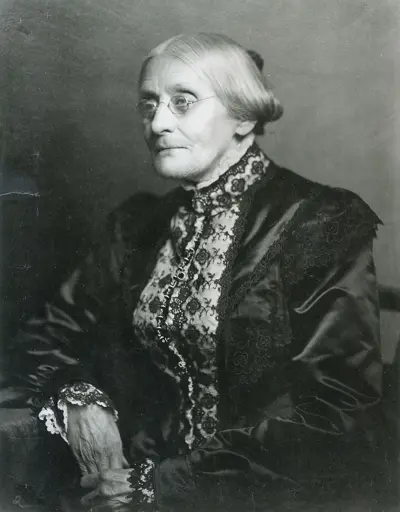
Susan B. Anthony was an American social reformer and women's rights activist who played a pivotal role in the women's suffrage movement. Born into a Quaker family committed to social equality, she collected anti-slavery petitions at the age of 17. In 1856, she became the New York state agent for the American Anti-Slavery Society.
