Ismail Serageldin Quotes
Muslim and Arab scientists ... took the torch and carried it for centuries, and if today the torch has passed to the West, we should be proud that we have done our share and more in earlier times, and should strive to take our place, by dint of hard work and innovation, alongside our Western colleagues at the forefront of the global endeavor to create a knowledge based, just and tolerant society.
In the Dark and Middle Ages, it was the Muslim scientists who were the most advanced and they also preserved and improved upon Western science and other knowledge when Christianity was so intolerant that science was made virtually impossible to carry out. Then the Islamic world started closing and became more intolerant of new thought and the Christian West began loosening up. Serageldin does not feel humiliated at the current weak scientific status of Islam and urges reform to again have Islam involved in world class science. Islamic modernists like Serageldin are many among educated Muslims but their views are often drowned out by the violence and extremist statements of the fundamentalists.
Ismail Serageldin, Egyptian Director of the Library of Alexandria & Historian, Member of the Egyptian Senate & World Bank Enviornmental VP & World Bank Enviornmental VP & World Bank Enviornmental VP, The Challenges of Cultural Diversity, 2007
Sourced by: Eigen's Political and Historical Quotations


Ibn Firnas was an Islamic Moor who first invented the glider and flew. Eilmer’s—see {588974}–achievement came afterward and may have been influenced by Crusader stories brought back about Ibn Firnas’s achievement.

In September of 2005 a Danish Newspaper published some political cartoons showing the hypocrisy of some Muslims who use Islam to justify murder of innocents and terrorism. Months later, in January of 2006 many in the Middle East protested vehemently and Muslim riots broke out because the Prophet Muhammad's visage was depicted against Islamic tradition. Many Muslim nations started a boycott against Denmark. Many Muslim leaders claimed that insulting religion was an “abuse” of freedom of speech including those from nations which regularly publish material that is virulent against Christians and Jews.
10 centuries ago was a time when the Arabs were far more advanced and modern than other cultures including the Christian West that was in the Dark Ages. However, in the 12th century there was a “closing”—a narrowing of allowable Islamic thinking, and since then, Islamic people have had great difficulty with change or modernity. Not all Muslim nations are equally rigid but the Arabs are at the extreme among Islamic counties.

The Arabs have a long history of arrogant and disdainful treatment by others given the British Colonial history in the Middle East, the French (who invaded Egypt under Napoleon), the Islamic Ottoman Empire which controlled the Middle East before that, and others. Along with the arrogance that usually comes with empire, Western support of the only democracy and modern state in the Middle East—Israel—was even more resented by the Arabs. Historically, there was a general feeling by much of the world that if the Arabs had no oil, no one would pay much attention to them. The Arabs naturally resented these attitudes. It was not until Nasser’s successor, Anwar Sedat, came to government in Egypt and King Hussein reformed Jordan, that Western attitudes began to change towards the Arab nations. The Western change was not because of any Arab “lesson” but the result of new, exceptionally capable leaders who have been reforming the Arab nations.


Turks and Arabs tend to blame each other for the stagnation of Islam.

He was contrasting the Islamic narrowness of today as compared with Islamic thinking at the height of the intellectual and scientific of 1000 years ago. See {623631}. Islamic modernists like Serageldin are many among the educated Muslims but their views are often drowned out by the violence and extremist statements of the fundamentalists.


Ibn al-Nafis was one of the great scientists of all time. He analyzed the human heart, lungs, and circulatory system. This quotation is often given by Muslim modernists and reformers to illustrate that Islam at one time was open to new knowledge, dissent, ideas of all kinds. A century later, Islam closed intellectually and later and even today, Muslims are killed for what became heresy. Truth became determined by the Koran and the words of The Prophet only, Christianity and the Church imposed a similar restrictive view of truth using the Bible and Jesus. However, the Reformation and modernity led Christianity to merge and adopt the more modern and scientific view with the exception of some Christian fundamentalists. Islam had the modern view and abandoned it causing the many educated Islamic reformers and modernists of today great difficulty in changing the culture and laws as a whole.


This quotation which appears absurd on the surface given Iran’s terrible record with religious minorities provides insight to Islamic orthodox thought. For the orthodox Muslim, Sharia—Koranic Law—is the basis of the society. God defines the rights of people and their obligations. Whatever rights are provided by Sharia, Khomeini and some others wished to provide them equally to religious minorities also. However, those rights do not include the right to criticize the Islamic law or the leaders who implement it. That would be heresy if done by a Muslim, a Christian, or a Jew. A Christian church may not erect a public cross or ring bells on Sunday. That is prohibited by the Koran and is imposed on all. Bahai religious adherents are tracked down in the Islamic Republic and are often executed. ‘What about their rights?’ they ask. The answer is that the Bahai were Muslims who have become “backsliders” and heretics, and under Sharia, they must be executed for heresy; they are deemed to be heretical Muslims and not members of a minority religion.

Darwish’s father, a Colonel in the Egyptian Army, was assigned by Nasser to Direct the Intelligence Operations for the Palestinian Terrorists in Gaza. After many Israelis were killed, the Israeli Defense forces targeted the Colonel and killed him. Nasser’s concept of revenge was to kill any Jews, anywhere, not the Jewish soldiers who had retaliated against his soldiers.


After Independence, the original credo of the Indonesian hero and leader was slowly ignored. The Muslim majority established Islam as the dominant religion and began to create laws that discriminated against Christians, Hindus, Buddhists, and Jews. The ethnic Chinese had been very successful in business and commerce and soon they were discriminated against and even physically attacked in Pogroms.


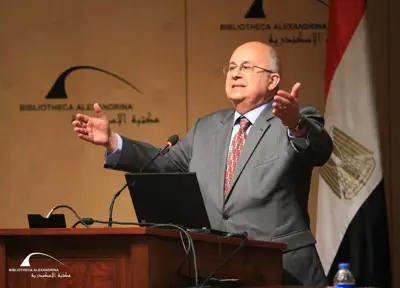
Ismail Serageldin (/ˈsɛrəɡɛldɪn/; born 1944 in Giza, Egypt), Founding Director of the Bibliotheca Alexandrina (BA), the new Library of Alexandria, inaugurated in 2002, is currently, Emeritus Librarian, and member of the Board of Trustees of the Library of Alexandria. He serves as Chair or Member of a number of advisory committees for academic, research, scientific and international institutions and civil society efforts, including as co-Chair of the Nizami Ganjavi International Center (NGIC), and serves on the Advisory Committee of the World Social Science Report for 2013 and 2016, as well as the UNESCO-supported World Water Scenarios (2013) and the executive council of the Encyclopedia of Life (2010) and Chairs the Executive Council of the World Digital Library (2010). He also co-chaired the African Union's high level panel for Biotechnology (2006) and again for Science, Technology and Innovation (STI) in 2012–2013, and was a member of the ICANN Panel for the review of the internet future (2013).
