John C. Calhoun Quotes
Mexico is to us the forbidden fruit; the penalty of eating it would be to subject our institutions to political death.
John C. Calhoun, 1782-1850, Vice President of the United States (Democrat, SC), U. S. Congressman & Senator (Democrat, SC), 1845
Sourced by: Eigen's Political and Historical Quotations

Emerson was right on both points. It was the first U. S. foreign policy effort where invading and conquering a country was much easier than dealing with it afterward.


One of the few vestiges of Nazism in Germany is the discrimination against all who do not have German blood. No matter how long an immigrant lives in Germany and contributes to the society, he cannot become a citizen unless his parents were German. This race phobia together with the classic competition for jobs between natives and immigrants which exists on many countries, make the German attitude toward immigrants unique. At the same time, there are other Germans who want to import more immigrant labor to grow the German economy.

The Mexicans had to agree to whatever terms the United States demanded. President Polk wanted to annex California and the New Mexico territory (included Arizona) as well as other territory including Baja—a territory much larger than Western Europe. Trist watered down the demand and only included California and the New Mexico territory.


The Polk Administration wanted War with Mexico but felt it would not have public support if the Unites States was the aggressor. So the Army was sent to the border to provoke the Mexicans to attack first. The strategy worked and President Polk had much more support since he claimed that Mexico had attacked American Soldiers and retaliation was necessary. In the aftermath of the Mexican War, the United States obtained much new territory including the Southwestern States and Mexico was destabilized.


The Governor was opposed to all involvement in politics by organizations other than the political parties – especially those which advocated reform. While the League became a non-partisan educational organization, at the time they worked to unseat some of the more sexist legislators including some of Miller’s allies.

The statement was made in response to Senator Lewis Cass argument that “We want room.” There is an interesting parallel between Corwin, and American arguing for the Mexican side, and that of William Pitt, an Englishman who made an argument for the Americans during the American Revolution. See {626047}.


The coup which deposed and then murdered Patrice Lumumba had the help of the American CIA and French Army. Lumumba was a Marxist and Mobutu appeared to be an anti-Communist. The corruption under Lumumba was typical of most African counties but Lumumba himself was an ideologue and but not personally dishonest. Under Mobuto, the Congo—renamed Zaire—became the most corrupt nation on earth, and Mobuto, one of the richest men in the world. Everything he complained of to justify is coup, he himself was guilty of when he consolidated power—moreso than any other 20th century world leader.

The final decision regarding the attack on Pearl Harbor and war with America had to be made. The Emperor Hirohito, Prime Minister Tojo, the full cabinet and leading elder statesmen were invited. Hara attended as one of the latter class. America had instituted an embargo of critical raw material whose end was contingent of Japan withdrawing from the territory that they had invaded and stop their territorial aggression in Asia, an aggression which some Japanese leaders—notably the military—was absolutely necessary to provide for the growing Japanese population and its increasing standard of living. At the time, an embargo was a powerfully effective weapon, which left Japan only two choices: Withdrawal or War. In modern times nations have chosen to endure and evade embargoes rather than be forced into undesirable positions.


See {633152} for more of the reasoning for this point. “Neocon” is a shortened form of “neoconservative”. At the time the neoconservatives were advocating use of military intervention in the Middle East. Munich was the German city in which British Prime Minister notoriously tried to appease Hitler and the Nazis. This led to WWII and has become the historical icon for appeasement of a powerful tyrant and the cost of such.


The Newspaper acknowledged that the conquest of Mexico was tantamount to a rape, but the editors were convinced that the Mexicans would be very happy once they were in the American orbit. In almost every case in American history where we invaded and occupied a country, the political leadership, most of Congress, and many American citizens were convinced that American freedom and democracy were so much better than any other form of government that the conquered people would not only welcome the Americans but would voluntarily reorganize their governmental structures to have a democracy. While there were always some people in each country who did feel that way, the majority rarely did, much to American surprise.

That was an ironic statement. Shortly thereafter we invaded Mexico, occupied the country, pressured it into “selling us much of what is now the Southwest of the United States, and finally left.

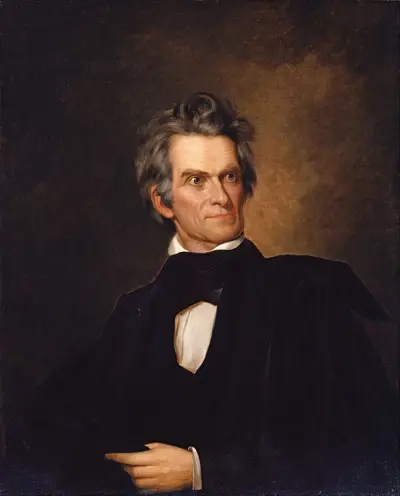
John Caldwell Calhoun was an American politician and political theorist from South Carolina who held many important positions including being the seventh vice president of the United States from 1825 to 1832, while adamantly defending slavery and protecting the interests of the white South when its residents were outnumbered by Northerners. He began his political career as a nationalist, modernizer, and proponent of a strong national government and protective tariffs. In the late 1820s, his views changed radically, and he became a leading proponent of states' rights, limited government, nullification, and opposition to high tariffs. He saw Northern acceptance of those policies as a condition of the South remaining in the Union. His beliefs and warnings heavily influenced the South's secession from the Union in 1860–1861.
