Thomas Corwin Quotes
If I were a Mexican, I would tell you, “Have you not enough room in your own country to bury your dead men? If you come into mine, we will greet you with bloody hands and welcome you to hospitable graves.
The statement was made in response to Senator Lewis Cass argument that “We want room.” There is an interesting parallel between Corwin, and American arguing for the Mexican side, and that of William Pitt, an Englishman who made an argument for the Americans during the American Revolution. See {626047}.
Thomas Corwin, 1794-1865, Governor of Ohio (Whig), U. S. Congressman & U.S. Senator (Whig & Republican, OH), Secretary of the Treasury, U. S. Minister to Mexico, Senate debate, February 11, 1846
Sourced by: Eigen's Political and Historical Quotations

The Princess was Victoria who was to become the Sovereign of England but at the time was only 11 years old. The Duchess was her mother and guardian and responsible for her upbringing and education. However, note that because a future sovereign was involved, the official Church of England was required by the existing law to provide oversight to her upbringing, and this memo was one of the Duchess’s periodic report to the Church. Also it is interesting that this young princess, destined to be the most powerful person in the world at the time, was brought up to “live for others” and not to be pompous or dazzled with power. The Duchess did a terrific job because not only was Victoria to reign over the British Empire for 62 years, but Queen Victoria is regarded by many historians as one of the best, if not the best, monarch who ever reigned anywhere.


Much of Mexican assets and land was owned by foreigners—especially Americans.

It was the beginning of the Zulu War.


As in most weak economic times there were more people than usual opposed to immigration. Of the opponents of immigration some were not racist, but a large number were very much racist. Also the racist organizations all opposed immigration. Historically almost all anti-immigration movements were racist. First it was against the Irish, then the Germans, followed by Chinese, Japanese, Italians, Eastern European Jews, and at the time of this quote it was against the Mexicans and other Hispanics.


When the British first colonized South Africa, the area they used was akmost uninhabited or very sparcely so. However, some Black tribes (including the Zulus) were moving from the north and themselves were colonizing or annexing the areas to their kingdom. The British were most interested in Trading so did not have large land asperations. The Dutch white Boer Africanners, in contrast, wanted to farm the lands and use the range for their cattle. They wanted the land. The English policy was that there would be friendly relations with the Black tribes surrounding their Cape Colony and no one should take their land. However the Boers started attacking the Black areas and seizing their farms and villages. At first, the English assumed that the Blacks would easily be able to ward off the invasion as the Afrikanners had no professional troops like the British. However, the neighboring tribes were not very warlike or good fighters. They were being overrun by the Zulus coming from the North and the Boers from the South. The British Government had a real problem in that they would have to have British soldiers fight the white Afrikanners if they wanted to stop the illegal white invasions. This was the root of the Boer War where the British would be fully at war with the Africanners.


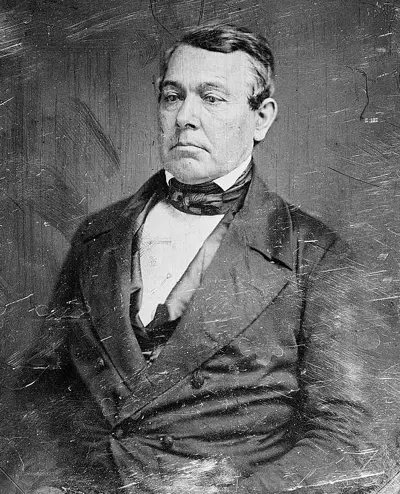
- Born: July 29, 1794
- Died: December 18, 1865
- Nationality:
- Profession:
Thomas Corwin, also known as Tom Corwin, The Wagon Boy, and Black Tom was a politician from the state of Ohio. He represented Ohio in both houses of Congress and served as the 15th Governor of Ohio and the 20th Secretary of the Treasury. After affiliating with the Whig Party, he joined the Republican Party in the 1850s. Corwin is best known for his sponsorship of the proposed Corwin Amendment, which was presented in an unsuccessful attempt to avoid the oncoming American Civil War.
