Nikola Tesla Quotes
Marconi is a good fellow. Let him continue. He is using seventeen of my patents.
Business associates tried to persuade Tesla to not allow Marconi to experiment with radio as he was using many of Tesla’s patents. Tesla was not driven by money and wanted to see Marconi develop new science which he did. Tesla was one of the great American immigrant scientists. He found in America the kind of intellectual and operational freedom that did not exist in the rigid, monarch-controlled, Austro-Hungarian Empire. He developed patents and techniques that formed the technological bases of radio, telephone long distance, TV, cell phones, Wi Fi, just to name a few. Most important he was Thomas Edison’s great nemesis. Edison invented DC electric generators that could power factories or entire streets in a neighborhood. Tesler invented and developed AC electrical technology which could power entire cities and he could move electricity over long distances which Edison could not. Tesler was one of the first scientists to conceive of and try to implement “Big Science” where there were huge capital investments to develop machines and systems to do what had never been done before—philosophically like the CERN Hadron Collider. Tesler even convinced a large corporation to finance the construction of a massive building and tower so he could experiment with the wireless transmission of electricity. However, as the industrial democracies have learned, Big Science can only be funded by governments and it often takes sever working in consort to afford the huge investment that is required. In Tesler’s era, the federal and state governments did not fund scientific research so his work was not only technically ahead of his time but also conceptually. He anticipated most of the problems and need for a national power grid that was challenging America even at the beginning of the 21st century.
Nikola Tesla, 1856–1943, Serbian Born Physicist, Inventor & Electrical Engineer, Quoted in PBS.org, "Who Invented Radio?", & in Daniel Blair Stewart, Tesla : The Modern Sorcerer, 1999
Sourced by: Eigen's Political and Historical Quotations


One of the limits of the patent systems for an individual or small company is the huge effort it takes to document an invention and enforce patent rights after getting a patent.


In the War of 1812, in retaliation of English facilities being attacked by Americans in Canada, the British raided Washington DC and burned the White House. They had also set up a battery of cannon in front of the Patent Office building—one of the most impressive in Washington—and were about to destroy it. The Superintendent came out with this speech. The British officer ordered the cannon removed and the Patent Office with its models was saved.


The economic advantage of the North over the South in the Civil War is well known. Not so well-known is the huge technological advantage that the North had. This quotation gives an indication of the extreme difference. The North fought the war on all fronts including the technological one where no weapons and methodologies from the telegraph to the military railroad were critical. The South by contrast did not have the manpower to fight the war and keep industry and scientific technological development going also.


One major purpose of the patent system is to get inventors to disclose their inventions and explain how they work and in exchange they get a temporary monopoly to profit from the invention. That is why all patents are available to the public so that science can advance if all other see how something was done. Despite the Douglas View, gadgets have been patented if they had some novel element to their functioning.

This principle justified the Government in allowing a local Indonesian company to manufacture anti-AIDS drugs without paying licensing rates demanded by the drug companies that held the patents. The principle is that patent rights and the desire to profit should not supersede the rights of people to continue to live because they cannot afford the drugs to keep them alive. The local manufacturers provide the drugs to the government at cost of manufacture which is a tiny proportion of the price the patent owner charges.


When Secretary of State, Jefferson ran the first American Patent Office. The Patent system was originally and educational program, not an intellectual property program. Inventors would keep all their technological secrets to themselves. The idea behind the original patent system was to give an inventor a limited monopoly on profiting from his invention in exchange for sharing his information and techniques with his countrymen—thus improving the technological competency of the entire society. The very first patents were available for public inspection for that reason. And even today, copies of patents are available easily for almost no cost. And few American ideas worked as well as our early patent system. Through its educational role and technology transfer, America came from technological nowhere to being the pre-eminent inventing nation of the world. The balance between public access to invention and innovation and preservation of some rights to the creator of intellectual property is key to modern development.

This quotation is an excellent statement of one major viewpoint about patents. However there are others who disagree and many who believe the existing patent system is broken and inhibits innovation. They observe that the vast majority of patents never are developed or reach the public. They also point to major counter-examples to Thomson’s view. The best is the PC which IBM developed and decided NOT to patent it, to encourage people to produce programs, applications and many devices. No product in human history has been more thoroughly developed and adopted by as many people as quickly. More capital investment money has been invested that any other invention. There are many examples where Thompson’s point holds. Vaccines for which there is no patent have not obtained any company who would manufacture it despite the need. The issue is complex with the old view of Thomson certainly not correct, but not entirely wrong either.

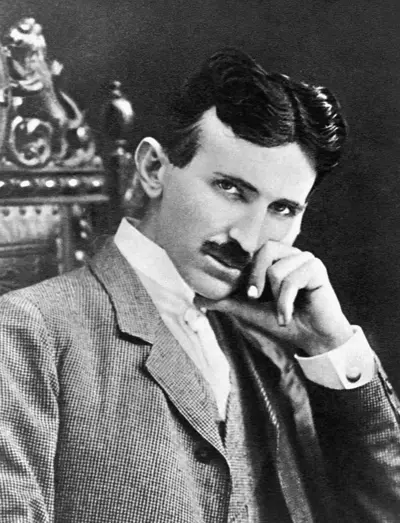
Nikola Tesla was a Serbian-American inventor, electrical engineer, mechanical engineer, and futurist best known for his contributions to the design of the modern alternating current (AC) electricity supply system.
