Richard Stallman Quotes
The patent system was established to encourage inventors to disclose the details of their inventions. Its purpose was to help society rather than to help inventors. At the time, the life span of 17 years for a patent was short compared with the rate of advance of the state of the art. Since patents are an issue only among manufacturers, for whom the cost and effort of a license agreement are small compared with setting up production, the patents often do not do much harm. They do not obstruct most individuals who use patented products.
Richard Stallman, Computer Software Programmer & Designer, Founder of the Free Software Movement, the Free Software Foundation, and the League for Programming, The GNU Manifesto, Essay at http://www.gnu.org/gnu/manifesto.html
Sourced by: Eigen's Political and Historical Quotations

Stallman and others opposed copywriting of software and felt that computer programs were ideas and as such should not be able to be legally monopolized but they had to live with the law as it was. They started the open source software movement where many programmers developed software and made it freely available to the world. However, there were many companies who would take the free software which was very good, package it with their own brand and sell it. Stallman then created the copyleft concept. This meant that the open source programmers legally copyrighted the program and then created a license that anyone could have for free. But the license only gave them the right to use the software or give it freely to others. Charging money would be a copyright violation. So he and many others since used the copyright law to prevent others from interfering with or making money from distribution and Stallman named it “copyleft” meaning the other side of copyright. Thousands of major programs have been distributed this way. In some areas. It has been so successful that the free software became much more widely used than the products of Microsoft, Oracle or any of the other commercial software developers. Website development has become an example. Not only do many use it because the price is right but much of the open source free software is the best of breed. The Obama White House used a copyleft, free program for the White House website, not because they would save money—the Clinton White House had already licensed excellent commercial software. They chose the open source Drupal package because they thought it was the best available at any price.

When Secretary of State, Jefferson ran the first American Patent Office. The Patent system was originally and educational program, not an intellectual property program. Inventors would keep all their technological secrets to themselves. The idea behind the original patent system was to give an inventor a limited monopoly on profiting from his invention in exchange for sharing his information and techniques with his countrymen—thus improving the technological competency of the entire society. The very first patents were available for public inspection for that reason. And even today, copies of patents are available easily for almost no cost. And few American ideas worked as well as our early patent system. Through its educational role and technology transfer, America came from technological nowhere to being the pre-eminent inventing nation of the world. The balance between public access to invention and innovation and preservation of some rights to the creator of intellectual property is key to modern development.


This is a very important quotation in the Patent world. One of the major justifications for giving patent monopoly to an inventor is that without the patent protection people would not invest time, effort or money to invent things. However many of the great inventors have not agreed. The original Constitutional purpose in granting patents was to stimulate disclosure of technology to other inventors and educate the nation. That is why all patents are public and can be viewed by all.

This quotation is an excellent statement of one major viewpoint about patents. However there are others who disagree and many who believe the existing patent system is broken and inhibits innovation. They observe that the vast majority of patents never are developed or reach the public. They also point to major counter-examples to Thomson’s view. The best is the PC which IBM developed and decided NOT to patent it, to encourage people to produce programs, applications and many devices. No product in human history has been more thoroughly developed and adopted by as many people as quickly. More capital investment money has been invested that any other invention. There are many examples where Thompson’s point holds. Vaccines for which there is no patent have not obtained any company who would manufacture it despite the need. The issue is complex with the old view of Thomson certainly not correct, but not entirely wrong either.
He worked for General Electric for over 40 years and held 322 patents. However, it was the corporation that financially benefitted from the monopolies granted by the patents. Our legal system assumes that the creative output of an individual who is an employee is the property of the employer just as the output of the slave was the property of the master.


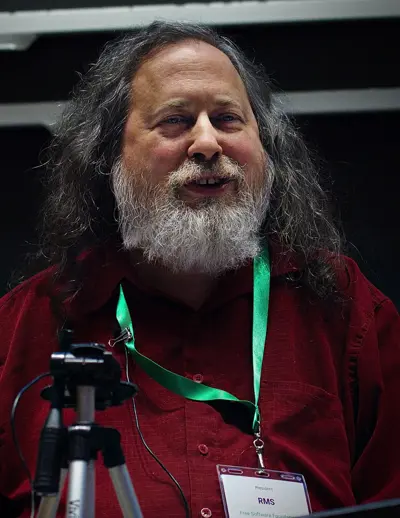
Richard Matthew Stallman, also known by his initials, rms, is an American free software movement activist and programmer. He campaigns for software to be distributed in a manner such that its users receive the freedoms to use, study, distribute, and modify that software. Software that ensures these freedoms is termed free software. Stallman launched the GNU Project, founded the Free Software Foundation, developed the GNU Compiler Collection and GNU Emacs, and wrote the GNU General Public License.
