Richard Stallman Quotes
All intellectual property rights are just licenses granted by society because it was thought, rightly or wrongly, that society as a whole would benefit by granting them. But in any particular situation, we have to ask: are we really better off granting such license? What kind of act are we licensing a person to do?
Richard Stallman, Computer Software Programmer & Designer, Founder of the Free Software Movement, the Free Software Foundation, and the League for Programming, The GNU Manifesto, Essay at http://www.gnu.org/gnu/manifesto.html
Sourced by: Eigen's Political and Historical Quotations

Stallman and others opposed copywriting of software and felt that computer programs were ideas and as such should not be able to be legally monopolized but they had to live with the law as it was. They started the open source software movement where many programmers developed software and made it freely available to the world. However, there were many companies who would take the free software which was very good, package it with their own brand and sell it. Stallman then created the copyleft concept. This meant that the open source programmers legally copyrighted the program and then created a license that anyone could have for free. But the license only gave them the right to use the software or give it freely to others. Charging money would be a copyright violation. So he and many others since used the copyright law to prevent others from interfering with or making money from distribution and Stallman named it “copyleft” meaning the other side of copyright. Thousands of major programs have been distributed this way. In some areas. It has been so successful that the free software became much more widely used than the products of Microsoft, Oracle or any of the other commercial software developers. Website development has become an example. Not only do many use it because the price is right but much of the open source free software is the best of breed. The Obama White House used a copyleft, free program for the White House website, not because they would save money—the Clinton White House had already licensed excellent commercial software. They chose the open source Drupal package because they thought it was the best available at any price.


When Secretary of State, Jefferson ran the first American Patent Office. The Patent system was originally and educational program, not an intellectual property program. Inventors would keep all their technological secrets to themselves. The idea behind the original patent system was to give an inventor a limited monopoly on profiting from his invention in exchange for sharing his information and techniques with his countrymen—thus improving the technological competency of the entire society. The very first patents were available for public inspection for that reason. And even today, copies of patents are available easily for almost no cost. And few American ideas worked as well as our early patent system. Through its educational role and technology transfer, America came from technological nowhere to being the pre-eminent inventing nation of the world. The balance between public access to invention and innovation and preservation of some rights to the creator of intellectual property is key to modern development.


At the time copyright, patents, and intellectual property in general were relatively new ideas. Property had in earlier countries been limited to tangible things—including people (wives and slaves). The Western world had in large part adopted the concept of intellectual property in law, but the average person’s thinking did not include these intangibles as “property.

Note that the only reason given in the constitution for protecting intellectual property was to promote the progress of science and useful arts. Inventors, would keep secret their inventions and techniques of manufacture and use in order to protect their economic interests. No one else would be able to benefit by understanding the invention and taking it further and increasing knowledge and understanding. So the Founding Fathers told Congress to establish a system where inventors would get a guarantee of a reasonable time to profit exclusively from the invention in exchange for making the invention public. The plans, methods and drawings had to be made public and until the 20th century a model of an invention had to be supplied to the Patent Office. Anyone could get an inexpensive copy of any patent and come and study the models. Today, most people believe that the reason for a patent system is to protect the intellectual property of the inventor, but that was not a purpose or even a serious consideration. The reason however was educational and to demystify technology and produce more science and technology which it did.


Vladimir Lenin. After the Russian Revolution the Soviet State rejected the use of a copyright and patent system with the notion that all intellectual property belonged to the state. According to some political economic theorists, this would portend great difficulty in obtaining innovative and creative output in the arts, industry, and sciences. However, in the next 50 years, Russia went from a backward nation to one of the most scientifically sophisticated in the world and their creative arts output, quality and quantity was second to none. They did not fare as well in consumer technology although their military technology was very powerful and all the more amazing considering where they were in 1918 when the Russians adopted these policies. The issue of whether artists, scientists, and inventors need exclusive control of their output in order to be motivated to create has been in dispute for years.

At first, there is an advantage to not recognizing copyright and allowing stealing from foreign publishers, but soon the point is reached where the practice precludes the country from developing its own writers and journalists. The same will likely be true for China and other nations where international copyright is not recognized or not enforced.

This doctrine of law was settled, but in the technological and digital age some people have tried to extend the intellectual property doctrine to include some ideas if they idea is a procedure or a set of DNA instructions. Meanwhile, the legal doctrine has been and is, as stated by Brandeis in this quotation, is that new and original ideas are not intellectual property and are always in the public domain, no matter how original.


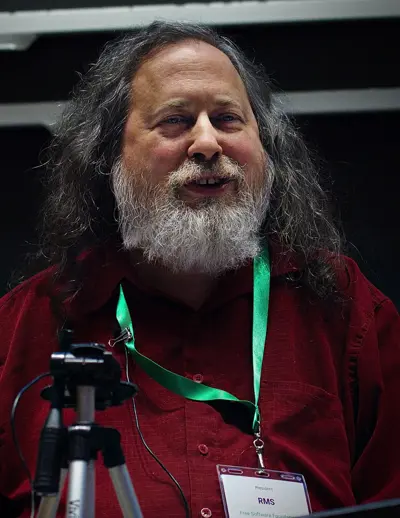
Richard Matthew Stallman, also known by his initials, rms, is an American free software movement activist and programmer. He campaigns for software to be distributed in a manner such that its users receive the freedoms to use, study, distribute, and modify that software. Software that ensures these freedoms is termed free software. Stallman launched the GNU Project, founded the Free Software Foundation, developed the GNU Compiler Collection and GNU Emacs, and wrote the GNU General Public License.
