Arthur Schopenhauer Quotes
If there is anything in the world that can really be called a man’s property, it is surely that which is the result of his mental activity.
At the time copyright, patents, and intellectual property in general were relatively new ideas. Property had in earlier countries been limited to tangible things—including people (wives and slaves). The Western world had in large part adopted the concept of intellectual property in law, but the average person’s thinking did not include these intangibles as “property.
Arthur Schopenhauer, 1788-1860, German Philosopher, Quoted in Library of Congress, Respectfully Quoted: A Dictionary of Quotations, 1993
Sourced by: Eigen's Political and Historical Quotations

50 years later a similar phrase was made famous be anarchist Pierre Joseph Proudhon.

He appears to be the first person to understand and write this important economic principle about science. Even in the 21st century, many economists are not aware of this critical principle.


There was a major debate about Congress changing the copyright law. Copyrights always had a life of 26 years and could be renewed once giving 52 years of monopoly protection. However, the copyright on Mickey Mouse was running out since it had been created 51 years earlier by Walt Disney. The modern Walt Disney company lobbied heavily for a change in the law. Other publishers joined them. Their major argument was that authors and creators of material need to have a strong incentive to write and do all the creative work to produce great materials. The change they wanted was to protect the work for the life of the author PLUS 100 years. The example that was given was the great American writer Nathanial Hawthorne who could not earn much money writing and spent part of his career doing other things. London publishers ripped off his popular books, but we did not have a copyright treaty with England. Valenti, a former eloquent politician and the spokesperson for Hollywood, observed that if Hawthorne had been better protected he might have written many more great works. However, Lessig turned the tables on him by pointing out that the 100 years after the death of the author during which the industry wanted protection would have no possible effect on the writing productivity of the creator. Dead people do not respond to economic incentives. It became clear that the argument of the industry that the change would protect authors and encourage them to create more, was a red herring and the only benefit would inure to the copyright holders and controllers and the author would not benefit at all. It was pure commercial desire to use the Federal law to get something valuable that they never had and the public would have gotten. However, the lobbying campaign was one of the best in American history and a benefit was taken away from the public and awarded to a small group of companies who paid handsomely with campaign contributions. A monopoly that no one could obtain in over 200 years of American history suddenly was obtained by a change in the copyright law.


Theoretically, this decree would have provided a fair amount of economic freedom for communist Russia. This decree gave some degree of comfort to the Western Europe and America, but had some major opponents within world communism who thought it too capitalistic. In practice the rights were never really available and this was one of the many “principles” of Soviet Communism which may have sounded reasonable but were never allowed to function in practice. Within a few years even the pretense of these principles was dropped.

When Secretary of State, Jefferson ran the first American Patent Office. The Patent system was originally and educational program, not an intellectual property program. Inventors would keep all their technological secrets to themselves. The idea behind the original patent system was to give an inventor a limited monopoly on profiting from his invention in exchange for sharing his information and techniques with his countrymen—thus improving the technological competency of the entire society. The very first patents were available for public inspection for that reason. And even today, copies of patents are available easily for almost no cost. And few American ideas worked as well as our early patent system. Through its educational role and technology transfer, America came from technological nowhere to being the pre-eminent inventing nation of the world. The balance between public access to invention and innovation and preservation of some rights to the creator of intellectual property is key to modern development.
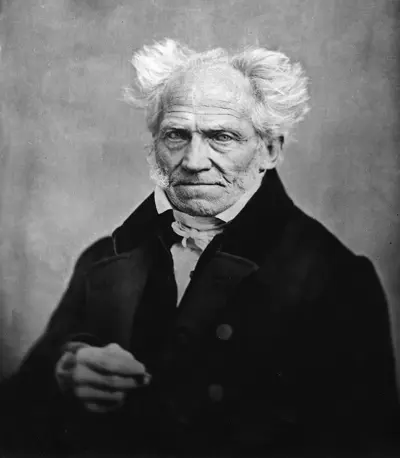
Arthur Schopenhauer was a German philosopher. He is best known for his 1818 work The World as Will and Representation (expanded in 1844), which characterizes the phenomenal world as the product of a blind and insatiable noumenal will. Building on the transcendental idealism of Immanuel Kant, Schopenhauer developed an atheistic metaphysical and ethical system that rejected the contemporaneous ideas of German idealism. He was among the first thinkers in Western philosophy to share and affirm significant tenets of Indian philosophy, such as asceticism, denial of the self, and the notion of the world-as-appearance. His work has been described as an exemplary manifestation of philosophical pessimism.
