Karl Marx Quotes
The product of mental labor — science — always stands far below its value, because the labor-time necessary to reproduce it has no relation at all to the labor-time required for its original production.
He appears to be the first person to understand and write this important economic principle about science. Even in the 21st century, many economists are not aware of this critical principle.
Karl Marx, 1818-1883, German Economist & Socialist, Addenda, "Relative and Absolute Surplus Value", Economic Manuscripts, 1861-63
Sourced by: Eigen's Political and Historical Quotations

At the time copyright, patents, and intellectual property in general were relatively new ideas. Property had in earlier countries been limited to tangible things—including people (wives and slaves). The Western world had in large part adopted the concept of intellectual property in law, but the average person’s thinking did not include these intangibles as “property.


Note that the only reason given in the constitution for protecting intellectual property was to promote the progress of science and useful arts. Inventors, would keep secret their inventions and techniques of manufacture and use in order to protect their economic interests. No one else would be able to benefit by understanding the invention and taking it further and increasing knowledge and understanding. So the Founding Fathers told Congress to establish a system where inventors would get a guarantee of a reasonable time to profit exclusively from the invention in exchange for making the invention public. The plans, methods and drawings had to be made public and until the 20th century a model of an invention had to be supplied to the Patent Office. Anyone could get an inexpensive copy of any patent and come and study the models. Today, most people believe that the reason for a patent system is to protect the intellectual property of the inventor, but that was not a purpose or even a serious consideration. The reason however was educational and to demystify technology and produce more science and technology which it did.


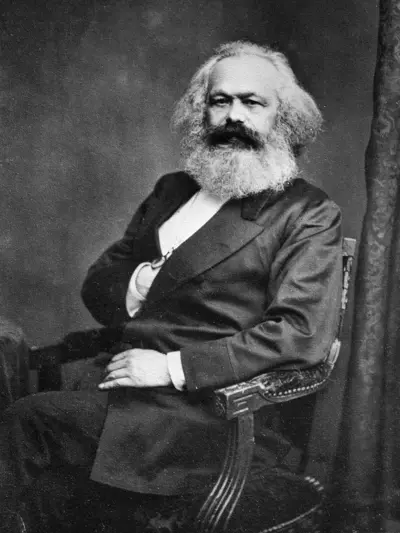
Karl Heinrich Marx was a German philosopher, economist, historian, sociologist, political theorist, journalist and socialist revolutionary. Born in Trier, Germany, Marx studied law and philosophy at university. He married Jenny von Westphalen in 1843. Due to his political publications, Marx became stateless and lived in exile with his wife and children in London for decades, where he continued to develop his thought in collaboration with German thinker Friedrich Engels and publish his writings, researching in the reading room of the British Museum. His best-known titles are the 1848 pamphlet The Communist Manifesto and the three-volume Das Kapital (1867–1883). Marx's political and philosophical thought had enormous influence on subsequent intellectual, economic and political history. His name has been used as an adjective, a noun, and a school of social theory.
