Judah P. Benjamin Quotes
The right of the inventor to his discovery, the right of the poet to his inspiration, depends upon those principles of eternal justice, which God has implanted in the heart of man.
Judah P. Benjamin, 1811-1884, U. S. Senator (Whig & Democrat, LA), Confederate Attorney General, Secretary of War & Secretary of State, Speech, U. S. Senate, March 11, 1858
Sourced by: Eigen's Political and Historical Quotations


She was referring to laws that supported slavery.

Note that the only reason given in the constitution for protecting intellectual property was to promote the progress of science and useful arts. Inventors, would keep secret their inventions and techniques of manufacture and use in order to protect their economic interests. No one else would be able to benefit by understanding the invention and taking it further and increasing knowledge and understanding. So the Founding Fathers told Congress to establish a system where inventors would get a guarantee of a reasonable time to profit exclusively from the invention in exchange for making the invention public. The plans, methods and drawings had to be made public and until the 20th century a model of an invention had to be supplied to the Patent Office. Anyone could get an inexpensive copy of any patent and come and study the models. Today, most people believe that the reason for a patent system is to protect the intellectual property of the inventor, but that was not a purpose or even a serious consideration. The reason however was educational and to demystify technology and produce more science and technology which it did.

This was a poem on copyright infringement which he held wrong. In American history, there has always been a significant part of the American population who were opposed to copyright on both moral and public policy grounds. In the first decades of existence, the United States did not legally recognize copyright. American publishers copied and republished English works with no compunctions. Benjamin Franklin was one of the worst offenders for people who saw it as an offence. English publishers and some American authors lobbied heavily in America and finally got Congress to pass copyright legislation. However, with every new technology, the battle is fought anew, and large numbers of Americans will use copyrighted material contrary to existing law and feel morally justified in doing so, Publishers and other owners of intellectual property then over compensate and they have lobbied heavily to stop what they call piracy by impinging what used to be the legitimate rights of consumers, readers and scholars—even those who were not violating copyright. It is another of those American political issues that never gets settled and is battled in almost every generation.


A classic potential conflict is between attaining liberty AND justice. In quest for one, the other can suffer. Many reforms and revolutions do not get this balance right.


This quotation is an excellent statement of one major viewpoint about patents. However there are others who disagree and many who believe the existing patent system is broken and inhibits innovation. They observe that the vast majority of patents never are developed or reach the public. They also point to major counter-examples to Thomson’s view. The best is the PC which IBM developed and decided NOT to patent it, to encourage people to produce programs, applications and many devices. No product in human history has been more thoroughly developed and adopted by as many people as quickly. More capital investment money has been invested that any other invention. There are many examples where Thompson’s point holds. Vaccines for which there is no patent have not obtained any company who would manufacture it despite the need. The issue is complex with the old view of Thomson certainly not correct, but not entirely wrong either.

In early America, the United States did NOT participate in the European International Copyright convention. The American purpose of copyright was not to protect authors and intellectual property owners, but to promote knowledge and culture. The original purpose was to limit the time during with an author could control his/her creative work so that the society as a whole can get maximum benefit. With the rise of large corporate intellectual property owners with strong lobbyists, they have been able to change the copyright law to greatly enlarge their time and methods of control. The Pirate Party wants to go back to the original intention of the Founding Fathers.

When Secretary of State, Jefferson ran the first American Patent Office. The Patent system was originally and educational program, not an intellectual property program. Inventors would keep all their technological secrets to themselves. The idea behind the original patent system was to give an inventor a limited monopoly on profiting from his invention in exchange for sharing his information and techniques with his countrymen—thus improving the technological competency of the entire society. The very first patents were available for public inspection for that reason. And even today, copies of patents are available easily for almost no cost. And few American ideas worked as well as our early patent system. Through its educational role and technology transfer, America came from technological nowhere to being the pre-eminent inventing nation of the world. The balance between public access to invention and innovation and preservation of some rights to the creator of intellectual property is key to modern development.


He had written this at the request of Joan van der Capellen, the Dutch revolutionist, to have a Christian theological justification for revolution against the then Dutch monarchy. See {639741} and {639742}.


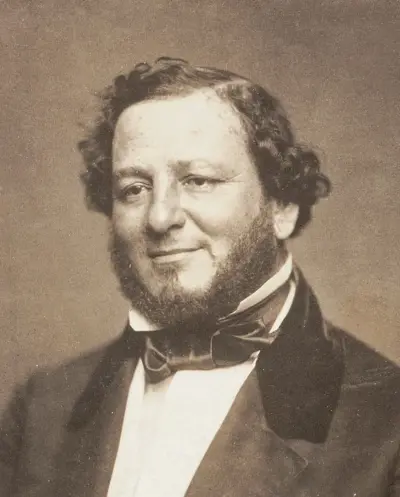
Judah Philip Benjamin, QC was a lawyer and politician who was a United States Senator from Louisiana, a Cabinet officer of the Confederate States and, after his escape to the United Kingdom at the end of the American Civil War, an English barrister. Benjamin was the first Jew to hold a Cabinet position in North America and the first to be elected to the United States Senate who had not renounced his faith.
