Henry Ford Quotes
Little White Slaver
Henry Ford, 1863-1947, Industrialist & Philanthropist, Unsuccessful Republican Michigan U. S. Senatorial Candidate [1918], Name for the cigarette, The Case Against the Little White Slaver, 1914
Sourced by: Eigen's Political and Historical Quotations


This quotation not only illustrates Ford’s wide ranging concern about public affairs but illustrates that the addictive properties of cigarettes were known long before the cancer and other disease causing properties of tobacco were understood. Yet the addictive properties were the last deleterious effects of smoking that the tobacco companies would admit to. At the end of the 20th century, the CEO’s of the major tobacco company all lied to Congress in hearings, claiming that cigarettes were not addictive. Ford and millions of people knew better generations ago.


As part of his sermon, Beecher would auction the freedom of a slave girl.


Southern secession and the Civil War This is one of the major quotations with which historians rebut the revisionist view that the Civil War was about States’ Rights or other economic factors.

Referring to Black Congressman Julian Bond: Louis Eugene Walcott

As a result of the programs and philosophy he expounded, Leontiev joyously predicted:

The Chinese laborers were slaves by most definitions of the word as they had been brought to South Africa on a system of indentured servitude. Slavery was illegal so the term had all kinds of political and legal significance. His statement was a masterpiece of admitting that it was almost slavery but leaving some wiggle room so as not to have classified it as such. Some use this as an example of Churchill’s capacity for hypocrisy.


This is one of the major reasons that Slavery was so hard to end in the South. At the time, the dollar value of the Southern slaves was greater than the value of all the land, factories, inventory, and capital equipment of the South. Slaves were not only capital, they were the largest component of Southern capital and Southern wealth. There were numerous ideas of paying slave owners for the freedom of their slaves, and if this was done, it would have been far less expensive in money alone than the Civil War cost. However, the Southern leadership, like Fitzhugh, were totally intransient with culture and customs—indeed the Southern concept of manhood—was dependent in Slavery. The result was that no compensation was paid to slave owners and the South was impoverished as a result of its capital loss and it would not recover for 150 years.
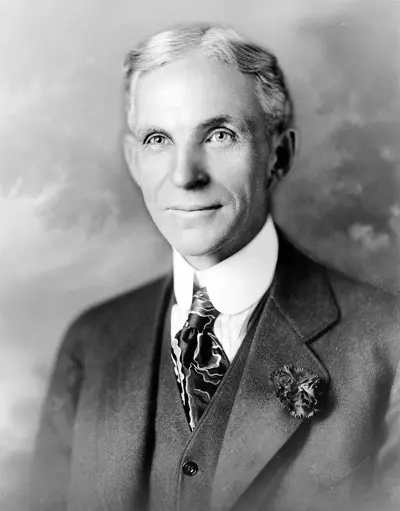
Henry Ford was an American industrialist, business magnate, anti-Semite, and founder of the Ford Motor Company and chief developer of the assembly line technique of mass production. By creating the first automobile that middle-class Americans could afford, he converted the automobile from an expensive curiosity into an accessible conveyance that profoundly impacted the landscape of the 20th century.
