Book of Exodus Quotes
Let my people go!
Old Testament, Exodus 5:1
Sourced by: Eigen's Political and Historical Quotations


This was one of the first calls for a slave strike in America.

The essential conundrum for the Southerners of the Early United States was their independence as individual states vis a vis the trust and dependence that would be required if they gave up much of their traditional authority to manage their own affairs. However, if they chose to maintain States’ rights and other States did as well, they not only lose the security and unity of a nation, but the other states were more economically powerful, better educated, with stronger infrastructures as well. The changing world politics, industrialization, and technology was making it more and more difficult for a Southern State to have it both ways. They could have a loose affiliation of states, maintain their own autonomy but would be saddled with war debt and a slave-dependent economy that was itself deteriorating. Or they would be in a strong union where they were the weaker economic and political forces and might be politically and culturally dominated by states like Pennsylvania, New York and Massachusetts which would force major social and economic reforms upon the South. The knot to which Lee referred was the mythical one so complex that non could untie it, but it could instantly be cut with a sword. Lee argued that the Southern states would have to accept the dominance of the other states (which was like political slavery) or just cut the knot and not ratify the Constitution. More negotiating and trying to untie the knot would be useless.


This fear was great among many who were abolitionists as potentially there might be mass slaughter of all Southern whites.


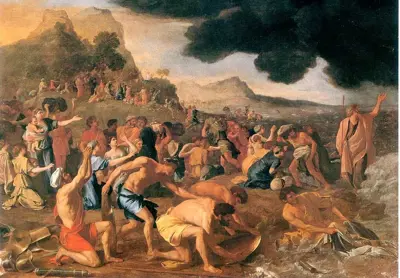
The Book of Exodus is the second book of the Torah and of the Old Testament. Starting with the deliverance of Moses by Pharaoh's daughter, it recounts the revelation at the Burning bush where he was called by Yahweh to deliver the Israelites from Egyptian slavery. After Pharaoh rejected his and Aaron's demands, according to the book, the Almighty inflicted ten Plagues on Egypt resulting in the Exodus. The Mosaic covenant was made at the biblical Mount Sinai, and subsequently the Tabernacle, with a "divine indwelling" of God with Israel.
