Rudolf Ludwig Karl Virchow Quotes
Laws should be made, not against quacks but against superstition.
Virchow, Rudolf. Die medicinische Reform, vol. 1, 1848.

Despite huge lobbying and political pressure, Dr. Kelsey would not sign off on the drug initially because she found information on her own about Thalidomide that the company, Merrell, must have known about and didn't reveal to her and her staff or in their applications. She was aware that the drug had been approved by England, Canada, and many nations of Europe, but she saw little data in the Merrell submissions and responses and that made her suspicious, and caused her to demand more. During the time the company was to submit more data, the reports of the deformed newborns were starting to come in from the countries that had approved the drug. When she gathered that information, she rejected the application and prevented thousands or perhaps tens of thousands of children to be born with missing limbs because their mothers had been treated with Thalidomide. In 1962 she was awarded the highest civilian medal by President John F. Kennedy.


American’s were purchasing more and more of the medicines from Canada which had been doing a much better job of price controls on medicine that the United States had done. Some pharmaceutical companies were blackmailing the minister and Canada by threatening to limit the sales so that if Canadians exported drugs they might not have that drug for Canadian citizens.

A Pure Food bill had failed to pass the Congress for years until Roosevelt took up the cause. The modern federal role in the quality control of food products had its origins with TR.


people for whom transfusions are proscribed Watchtower Bible and Tract Society of New York


Huntington, one of the better known political scientists had been nominated for admission as a fellow of the National Academy of Sciences. He was generally considered a shoe-in. However, some of his research had used extensive mathematical analysis to prove his conclusions. Lang a gadfly had actually read Huntington’s peer reviewed published Journal articles and found that the mathematics was very faulty, both in its application and execution. He opposed Huntington’s election and proceeded to present Huntington’s mathematics and conclusions to the members, who were themselves the best scientists of many different disciplines. They all realized that the Huntington work was incorrect. Huntington argued that as a Political Scientist he was using mathematics as a way of conceptually illustrating his points and not in a rigorous manner. Huntington was not elected to the academy. Lang frequently would take scientific evidence offered in Congressional Hearings, analyze it and then send a package to the media and members of Congress showing the errors. See {508154} for his cutting style with poor science.

When the priest died, 3 handwritten manuscripts were found written and signed by him in which he attacked religion in general and the church and the Bible in particular. His Testament was read by Voltaire and Denis Diderot among others and he was very influential in their development as opponents of organized religion. This quotation has been one of the bases of secular humanism which would then develop after he had died.


This scientific quotation is politically important because it defines the difficult problem of setting acceptable and safe environmental and work standards for air or water quality and contact with potentially toxic substances. As this quotation illustrates, everything is toxic if given in large enough doses. Table salt can kill a human if enough if ingested. Tiny amounts of even a poison will do no harm. What makes setting of standards still more complicated is that human beings differ in the amount of a substance it would take to produce a toxic reaction. Allergies are the best example, but the variability of sensitivity always exists.

1st Baron Macaulay. This issue is still debated in America. Until the latter part of the 20th century, businesses could sell supposed medicines without any proof of efficacy or safety. The Government or others had to prove that there was something wrong with the product. Then, that shifted, and the burden of proof fell on the developer and seller of medicines as Macaulay favored, but sellers of vitamins and dietary supplements were exempted and operated under the previous American (anti Macaulay) position. Ironically, political opponents of requiring the drug company to prove safety and efficacy claimed that this was a radical new, untested idea that would inhibit development of medicinals. They did not realize that 150 years earlier, this was a standard, accepted point of view in England. Even into the 21st century, America operated with the inconsistent difference between vitamins and supplements, many of which have no beneficial effect whatsoever, and medicines.


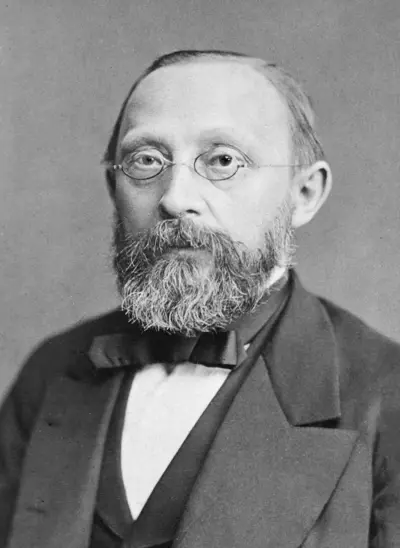
Rudolf Ludwig Carl Virchow was a German physician, anthropologist, pathologist, prehistorian, biologist, writer, editor, and politician. He is known as "the father of modern pathology" and as the founder of social medicine, and to his colleagues, the "Pope of medicine".
