Benjamin H. Hill Quotes
Tinkers may work, quacks may prescribe, and demagogues may deceive, but I declare to you that there is no remedy for us ... but in adhering to the Constitution.
Benjamin H. Hill, 1823-1882, U.S. Congressman & U.S. Senator (Democrat, GA), Senator in the Confederate Congress, Quoted in B. Hill Jr., Senator Benjamin H. Hill: His Life, Speeches & Writings, 1893
Sourced by: Eigen's Political and Historical Quotations


Powell was the Secretary of State and Addington kept advising the administration that as long as the President was acting in defense of the country in his capacity as Commander in Chief, he did not have to obey any existing laws that had been Constitutionally passed which in the opinion of the President restricted or limited the President or the executive branch. Addington was an attorney and Assistant to the Vice President, but he was given much responsibility for administration policy. Powell the Secretary of State of the Administration could not have disagreed more and although most politicians including Republicans disagreed with the Addington thesis, Powell was one of the few Republicans to criticize the Addington position.


Senator Grimes thought that Andrew Johnson was a terrible President, but when the House of Representatives impeached President Johnson and he was tried before the Senate, Grimes voted for acquittal. His reason for the his vote was he thought that the Constitution did not provide for the removal if a President just because he has “Unacceptable.” Johnson survived removal from office by a single vote and had Grimes not been so principled about the Constitution, Johnson would have been removed from office. On the other hand, Johnson was a terrible President and many of the nations racial problems in later years emanated from his actions and inactions while in office.


In a 1949 dissenting opinion in Terminiello v. Chicago Jackson claimed the majority view would “convert the Bill of Rights into a suicide pact.”

Many state officials have always felt that way. However, history has shown that while no model of perfection, the Congress has been less corrupt than the state legislatures. Many leave state legislatures to run for Congress; almost no one leaves Congress to run for the state legislature.


The Presidential election of 1800 produced a crisis even greater than that of 2000. There was an Electoral College tie between Thomas Jefferson and Aaron Burr—both of the same party, Democratic Republicans. The Federalist Party led by President John Adams had been totally rejected by the voters and Adams was in third place. However, the Federalists saw an opportunity of maintaining the Presidency anyway. The Constitution threw the election into the House of Representatives with each State delegation having a single vote. In the House, the Federalists had parity with Jefferson’s party which resulted in 35 tie votes. Finally, Congressman Bayard, the sole Congressman from Delaware, withheld his vote on the 36th ballot, thereby electing Thomas Jefferson of the opposition party. His reason was:


Though Ryan was not necessarily a proponent of Southern secession, he was an outspoken critic of the Lincoln administration’s misuse of Constitutional powers in the Civil War.
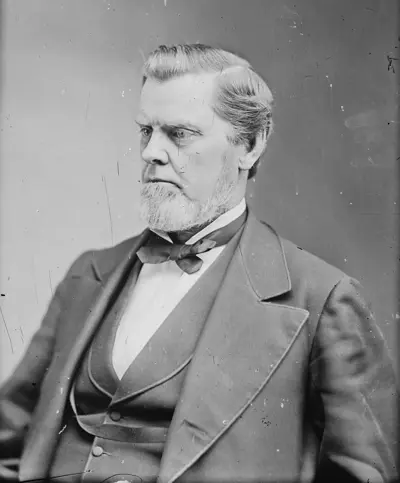
Benjamin Harvey Hill was a politician whose career spanned state and national politics, and the Civil War. He served in the Georgia legislature in both houses. Although he had opposed secession, he stayed with the South and served as a Confederate senator representing Georgia.
