Lyndon B. Johnson Quotes
Just like the Alamo, somebody damn well needed to go to their aid. Well, by God, I'm going to Viet Nam's aid!
Halberstam, David. The Best and the Brightest. Random House, 1972, p. 533.

sending American troops to Vietnam


President Eisenhower was asked if there was any danger of the country getting inadvertently drawn into a war in Vietnam as the result of sending military "advisors":

Chomsky was not asserting this statement as the truth. He was making the statement assuming that the absurdity of it would be clear to the listener and they would also realize that was what the then government policy was. North Vietnamese had infiltrated the South and had much support in many of the South Vietnamese villages. When the U. S. bombed the North Vietnamese—and the Vietnamese inhabitants—of those villages, the intention was indeed to help the South Vietnamese. If Chomsky were a politician running for office, his opponent might well have taken this quote and used it to “prove” that Chomsky supported the American effort in the Vietnam War when he was a vehement opponent.


Most Americans had not then realized that American troops had gotten involved in the Vietnamese Civil War. For some this was shocking. Kennedy helped his brother, President Kennedy, arrange for a coup to replace President Ngo Dinh Diem in which the man we pledged to “stand by” was murdered. He turned out to be thoroughly corrupt, and had little if any more respect for democracy and human rights than the North Vietnamese leadership did. Nonetheless we broke a pledge to an ally. This and similar promises that are not kept complicates American diplomacy as there is rarely complete trust in the pledges of American officials.

Most socialists in American and elsewhere initially supported the United States policy of intervention in the Vietnamese civil war. While they disapproved of much of the general economic policy, the Russian, Chinese and other Communist trampling on human rights seemed like a worse alternative.
The “help” was a covert CIA 1954 operation that overthrew the government


Before American entry into the War with Japan, Chiang Kai-shek and the Soongs maintained that they were fighting the Japanese but it was not generally true. They were fighting Mao and his Communists while Mao was fighting the Japanese. By 1942, under pressure from the United States and Russia, the Nationalists and Communists agreed to a truce so that they could both fight against Japan. Based on the promises made to President Roosevelt by Madam Chiang, the Soongs, and Chiang himself, there was an expectation of extensive military attacks against the Japanese. The U. S. then sent a large amount of military aid to Chiang Kai-shek, but there did not appear to be any significant attacks against the Japanese other than those mounted by the Communists. Magruder, General Marshall’s emissary to Chiang Kai-shek was instructed to investigate. When the war ended, Chiang Kai-shek used the assets he was saving in to attack Mao and his communists just as he had done before the truce. Magruder had been right. However, just as Chiang could not defeat the militarily inferior Communists before the truce, he could not do so after. Soon Mao turned the tables and drove Chiang Kai-shek and his Nationalists out of Mainland China. President Roosevelt had brilliantly judged the ability of England, Russia, and Yugoslavia to fight the Germans, but as this quotation and {641677} shows, he listened to the wrong people. He had been sold a “bill of goods” by the China Lobby, the Soongs and Chiang Kai-shek.


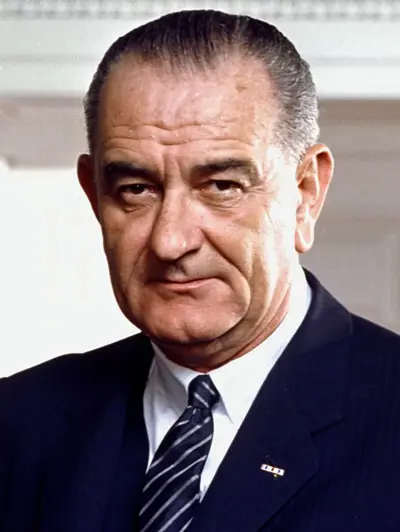
Lyndon Baines Johnson, often referred to by his initials LBJ, was the 36th president of the United States, in office from 1963 to 1969. He served as the 37th vice president from 1961 to 1963 and assumed the presidency following the assassination of President John F. Kennedy. A Democrat from Texas, Johnson was also a United States representative and later majority leader in the United States Senate. Johnson is one of only four people to have served, at various times, in all four federal elected positions.
