Woodrow Wilson Quotes
Japan’s rise in Asia while the European nations are bogged down [in WWI] threatens white supremacy on this planet.
Wilson was a virulent racist—the worst in this respect since Andrew Johnson. Blacks were not his only target. Anything that threatened white supremacy was a problem for him.
Woodrow Wilson, 1856-1924, 28th President of the United States (Democrat, NJ), Statement during WWI, Quoted in Adam Tooze, The Deluge, 2014
Sourced by: Eigen's Political and Historical Quotations

This quotation shows that the racism and master race of Nazi Germany was a norm in Germany well before Adolf Hitler and the Nazis. It was an endemic part of the culture. This makes the German post WWII reforms all the more remarkable as the vast majority of an entire nation had to radically change its world and personal views and perceptions.

While the Western nations were doubtless guilty of blatant racism and anti-Asian discrimination, the Japanese protest was tainted with a substantial degree of hypocrisy. At the Versailles Peace Treaty negotiations the Japanese argued strenuously for equal treatment of Japanese by the West but did not favor extension of the equality principle to Koreans, Chinese, Thais, Chomoros, and other Asian peoples. Japan itself, led by its Emperor, considered other Asian people racially and culturally inferior. Thus they were the inherent leaders of Asia and all Asian people.

Lindbergh, a great aviator, was a Fascist who was a great admirer and supporter of Hitler and Mussolini. He appeared to be tragically foolish, when 2 years later, the Japanese, with almost perfect precision, carried out the then largest and most successful air attack when they bombed and strafed Pearl Harbor. The entire attack was made from aircraft carrier based planes, the hardest and most technically complex of air operations.


This quotation illustrates how extensive and virulent anti-Asian racism had become. Gompers was a left wing liberal, but also a labor leader, and the prospect of millions of oriental immigrants competing for the existing American jobs was frightening. The irony of this quotation was that most of the labor constituency that Gompers represented had been immigrants or were the children of immigrants who earlier had frightened American workers and whose ethnicity had been opposed—Irish, Italians, Jews.


This is an important quotation because Buckley was the leading intellectual conservative of his day. And he held these racist views more than a decade after the Civil Rights Act and Voting Rights Act were passed. Buckley was an elitist with an Ivy League education, and he did believe that there was nothing inherent or permanent in the Southern Black inferiority, but there were few people of his educational level who had these racist beliefs. Not all conservatives of the time were as racist as Buckley. Even into the 21st century Conservative groups like the Tea Party had a strong but minority vestige of racism.

The KKK were riling up the white shrimpers because Vietnamese-American fishermen were fishing in ‘their waters”. The Southern Poverty Law Center, on behalf of the Vietnamese Fishermen, sued the KKK in Federal Court and won an injunction prohibiting the Klan from continuing its training program to burn the Vietnamese-American’s boats. Some of the Vietnamese-American fisherman had fought agaist the Viet Cong in Vietnam before coming to American and they armed themselves with shotguns and rifles, Faced with legal and possible violent resistance, Beam and the Klansmen disappeared from the area.


This classic quotation illustrates several things. First, the degree of racism that existed in 1944 in West Virginia. Second, not how young Robert Byrd immediately leaped from the possibility of integrating our fighting forces to interracial sex. That has been typical of white racism in America—a preoccupation with race and sex. Last, Byrd who became a member of the KKK, completely changed his mind over the year and ended up supporting the things that, as a youth were worse than the demise of the nation. He matured and grew on the race issue as much of the country did and ended as a strong supporter of equality and civil rights—including affirmative action.

She was one of the first prominent white southerners to denounce racial segregation.
the white Southern racist system She was one of the first prominent white southerners to denounce racial segregation.

The fascist, military clique that ran Japan at the time had no respect for treaties or International Law as understood by most Western nations. China was a land of warlords and corrupt military leaders. There was then an extensive history of Anti-Asian feeling and activity in America. Stimson, made the classic mistake of correctly assessing the Japanese leaders but generalizing from them and some Chinese corrupt military leaders to all Asians and their governments. Indeed, after the American occupation of Japan ending WWII, the Japanese adapted to democracy very well and have been instrumental in making and keeping many international treaties,

He was advocating separation of the races.


Booth was the younger son of a very prominent Northern family of actors. His older brother was considered the greatest American actor, and the rest of the family were abolitionists and vehement Union supporters. They found young John’s views reprehensible.

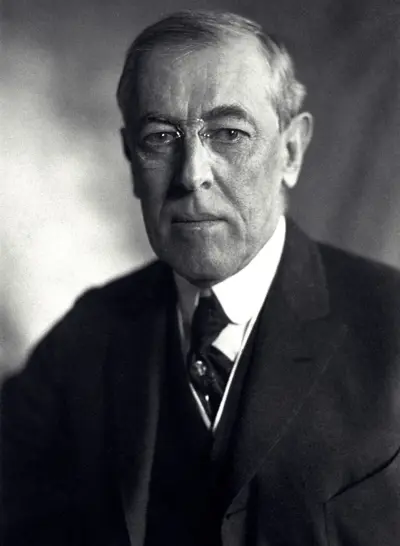
Thomas Woodrow Wilson was an American politician and academic who served as the 28th president of the United States from 1913 to 1921. A member of the Democratic Party, Wilson served as the president of Princeton University and as the 34th governor of New Jersey before winning the 1912 presidential election. As President, Wilson led the United States into World War I in 1917. He was the leading architect of the League of Nations, and his progressive stance on foreign policy came to be known as Wilsonianism. Scholars have generally ranked Wilson in the upper tier of U.S presidents, although he has been criticized for supporting racial segregation and white supremacy.
