Hirohito Quotes
Everywhere in the world discrimination between yellow and white remained, as in the rejection of immigration to California and the white-only policy in Australia. These were sufficient grounds for the indignation of the Japanese people.
While the Western nations were doubtless guilty of blatant racism and anti-Asian discrimination, the Japanese protest was tainted with a substantial degree of hypocrisy. At the Versailles Peace Treaty negotiations the Japanese argued strenuously for equal treatment of Japanese by the West but did not favor extension of the equality principle to Koreans, Chinese, Thais, Chomoros, and other Asian peoples. Japan itself, led by its Emperor, considered other Asian people racially and culturally inferior. Thus they were the inherent leaders of Asia and all Asian people.
Hirohito, 1901-1990, Emperor of Japan, Response to interrogations regarding the atmosphere in Japan prior to World War II, 1946
Sourced by: Eigen's Political and Historical Quotations


This quotation illustrates how extensive and virulent anti-Asian racism had become. Gompers was a left wing liberal, but also a labor leader, and the prospect of millions of oriental immigrants competing for the existing American jobs was frightening. The irony of this quotation was that most of the labor constituency that Gompers represented had been immigrants or were the children of immigrants who earlier had frightened American workers and whose ethnicity had been opposed—Irish, Italians, Jews.
Description of the Dutch Reformed Church in South Africa in the 1730’s

This report was submitted to President Franklin D. Roosevelt, who accepted the recommendation and signed Executive Order 9066. The Japanese on the West Coast were then rounded up and interned by DeWitt in what was one of the lowest and disgraceful points in American history. A national apology was made 34 years later. See {635792}.
This racist officer was the impetus for one of the terrible wrongs in American history but most of the national establishment and FDR himself signed off on it to his everlasting disgrace. See {587961} and {635792}.

Warren a Republican from California who knew Palmer for years, stood up, put his arm around Palmer and told him, “Kyle, you and I will always be friends” and walked out.


Booth was the younger son of a very prominent Northern family of actors. His older brother was considered the greatest American actor, and the rest of the family were abolitionists and vehement Union supporters. They found young John’s views reprehensible.


He was advocating separation of the races.


This classic quotation illustrates several things. First, the degree of racism that existed in 1944 in West Virginia. Second, not how young Robert Byrd immediately leaped from the possibility of integrating our fighting forces to interracial sex. That has been typical of white racism in America—a preoccupation with race and sex. Last, Byrd who became a member of the KKK, completely changed his mind over the year and ended up supporting the things that, as a youth were worse than the demise of the nation. He matured and grew on the race issue as much of the country did and ended as a strong supporter of equality and civil rights—including affirmative action.

1st Viscount Shibusawa. Not only was there gross discrimination—mostly in the Western States—against the Japanese, but they were subjected to physical harassment and violence.

Noble and Holy Order of the Knights of Labor. This usually progressive organization advocated the 8 hour work day and control of child labor but when it came to competitors for their members jobs, they became a leading racist and anti-Chinese immigration voice in America. The irony of this quotation was that most of the labor constituency that the Knights represented had been immigrants or were the children of immigrants who earlier had frightened American workers and whose ethnicity had been opposed—Irish and Italians.

Theodore Roosevelt, became President when President McKinley was assassinated. One thing that he did was to have the Negro leader, Booker T. Washington to lunch at the White House. He had previously had Blacks in his famous Rough Riders. Although Roosevelt had not taken a public position in inter-racial marriage, in the South, and much of rest of the country, accusing someone of favoring miscegenation was as serious an insult as there was. The accusation was used to attack anyone who did not favor segregation, lynching and Jim Crow in the same way that people who favored Medicare or Labor Unions were called “communists”. Cardamon himself was the target of many for his disrespectful and gross description of the president. See Quotation

Referring to Montgomery Alabama in 1950.


This statement shortly after the Japanese attacked Pearl Harbor, was remarkably prescient. The last sentence was exactly what happened although at the time some criticized him for being too paranoid about racial matters.

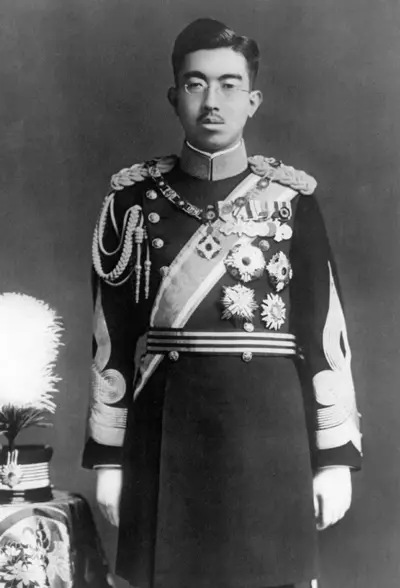
Emperor Shōwa, better known in English by his personal name Hirohito (裕仁), was the 124th emperor of Japan according to the traditional order of succession, ruling over the Empire of Japan from 25 December 1926 until 2 May 1947, after which he was Emperor of the state of Japan until his death. He was succeeded by his fifth child and eldest son, Akihito. Hirohito and his wife, Empress Kōjun, had seven children, two sons and five daughters. By 1979, Hirohito was the only monarch in the world with the title "emperor." Hirohito was the longest-lived and longest-reigning historical Japanese emperor and one of the longest-reigning monarchs in the world.
