Chesty Puller Quotes
I've always believed that no officer's life, regardless of rank, is of such great value to his country that he should seek safety in the rear... Officers should be forward with their men at the point of impact.
Hoffman, Jon T. Chesty: The Story of Lieutenant General Lewis B. Puller. Random House, 2001, p. 220.


Ataturk was a young major at the time commanding troops of a weak and corrupt Ottoman regime. However a combined English and French (the strongest military powers in Europe) invasion of the Gallipoli Peninsula threatened to capture the Turkish capital, Constantinople. Ataturk alone rallied the Turkish defenders and fought the invaders to a standoff in long drawn out battle with huge casualties on both sides. Ataturk became a national hero. Although Ataturk thereafter was very reluctant to use military force or endanger troops, the thing he always thought worth the supreme sacrifice (including his own) was the independence and sovereignty of the nation. See {584502} for his continuing belief in this type of sacrifice.

Westmoreland’s critics point to this quotation as an illustration of exactly why he was the wrong man for the job. As Vietnam Supreme Commander, he controlled more firepower than any other military leader in history and yet he had “no room” for thought or reason much less mercy. Subsequent commanders of U. S. military efforts were much more sophisticated like, Colin Powell, Norman Schwarzkopf, and Wesley Clark who were leading American thinkers, sophisticated at political and military reasoning and very capable of mercy. The modern American military requires men and women who are skilled at thinking and reasoning.

Adams, after his presidency, served in the House of Representatives for many years. He collapsed at his desk in the House and died in the Speaker’s office.


He always appeared in a military uniform after that.


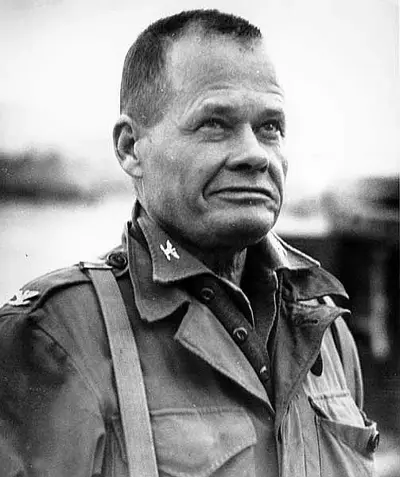
Lewis Burwell "Chesty" Puller served as a United States Marine Corps officer. Beginning his career fighting guerillas in Haiti and Nicaragua as part of the Banana Wars, he later served with distinction in World War II and the Korean War as a senior officer. By the time of his retirement in 1955, he had reached the rank of lieutenant general.
