Giuseppe Garibaldi Quotes
Anyone who wants to carry on the war against the outsiders, come with me. I can’t offer you either honours or wages; I offer you hunger, thirst, forced marches, battles and death. Anyone who loves his country, follow me.
Giuseppe Garibaldi, 1807-1882, Italian General and Political leader, Garibaldi
Sourced by: Eigen's Political and Historical Quotations

Ataturk was a young major at the time commanding troops of a weak and corrupt Ottoman regime. However a combined English and French (the strongest military powers in Europe) invasion of the Gallipoli Peninsula threatened to capture the Turkish capital, Constantinople. Ataturk alone rallied the Turkish defenders and fought the invaders to a standoff in long drawn out battle with huge casualties on both sides. Ataturk became a national hero. Although Ataturk thereafter was very reluctant to use military force or endanger troops, the thing he always thought worth the supreme sacrifice (including his own) was the independence and sovereignty of the nation. See {584502} for his continuing belief in this type of sacrifice.


Quintus Horatius Flaccus


A Federal Naval flotilla was preparing to attack South Carolina Forts Beauregard and Walker in the area of Hilton Head and Port Royal. The navy took both forts the next day with their naval bombardment so powerful that the Confederate Rebels had to abandon both forts gaining a kind of revenge for the Confederate capture of Fort Sumter at the war’s beginning.


Ataturk had been a military hero, but was very much opposed to war and military adventurism not unlike the Dwight Eisenhower and Colin Powell type leaders. However, the one thing that he thought worth the sacrifice of his own and other Turkish lives was Turkish independence and sovereignty. Historically, the Ottoman Empire which Ataturk finally ended, had dominated half of Europe and all of the Mid East at the cost of sovereignty of other nations and Ataturk saw no more important virtue with dying for than national sovereignty. See {125322} and {584501}.

Reports were widespread that General Grant was an alcoholic and was frequently drunk in the field. Lincoln was under pressure to relieve Grant of his command in the West. To a Pennsylvania politician he explained:


This line was used in the WPA Federal Theater Project. The play was closed down, because the State Department was distressed that the Federal Theater quoting heads of State might be insulting to the world leaders. Mussolini was another character in the play and he was depicted as the boorish thug that he turned out to be. It was that which offended the government officials who closed the show before it could open. FDR used a similar line 6 years later. See {32529} . Dolores Ibarruri in the Spanish Civil War is quoted with a similar phrase at about the same time. See {604321}


The American Army had just liberated Bellau Wood, but had lost almost 8,000 men.


“Volk” loosely translated means “the people.” However it carries the connotation of a unity that “the people” does not.

Clark had Hancock and Adams for dinner. Paul Revere arrived to announce that “the British are coming.” The guests asked Reverend Clark if he thought that the people of Lexington would fight. They did, and some died.
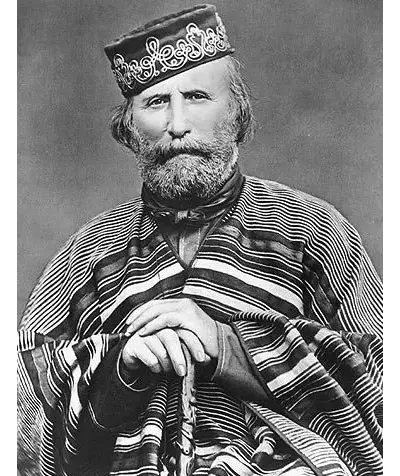
Giuseppe Maria Garibaldi was an Italian general, patriot and republican. He contributed to the Italian unification and the creation of the Kingdom of Italy. He is considered to be one of the greatest generals of modern times and one of Italy's "fathers of the fatherland", along with Camillo Benso, Count of Cavour, Victor Emmanuel II of Italy and Giuseppe Mazzini. Garibaldi is also known as the "Hero of the Two Worlds" because of his military enterprises in South America and Europe.
