Ann Coulter Quotes
It's just like a liberal, they import slaves, they hold slaves, they fight for slavery, they go to war in a civil war to defend slavery. They then install legal discrimination against blacks for a hundred years.
Coulter, Ann. Mugged: Racial Demagoguery from the Seventies to Obama. Regnery Publishing, 2012.

Phelps was a Copperhead Democrat who was a virulent racist, an enemy of Lincoln and supported McClellan against Lincoln in 1864. His extreme disrespect for the President and his racism was not appreciated in Vermont, and Phelps not only failed to help McClellan but destroyed his own credibility in his home state of Vermont. Phelps had been practicing law in New York City where there was a large Copperhead, racist and anti-Lincoln part of the population there.


The first sentence is inscribed on the Jefferson Memorial in Washington DC. The last two sentences are rarely quoted.


that person will be committed


Incredibly enough, after the Civil War and emancipation, most Virginia leaders opposed any form of rights for Blacks with one of the major reasons being that they were ignorant and uneducated. It was actually a crime to teach even a free Black to read.

Religion has been on both sides of the racism issue. In general, slavery the world over and in the American South needed the support of mainstream religions. At the same time, religion has been one of the major forces for abolition. The two mainstream Protestant religions of the South, the Baptists and the Methodists split from their Northern brethren in the 19th century over the slavery issue, and they have never united.

This quotation is very interesting historically. Despite the fact that Washington DC was a thoroughly racially segregated city, and the Southern racists controlled much of Congress, Blacks as well as whites were welcome in the Congressional galleries, and they attended many debates. Slavery and equality were not just debated in the 1850s but the issue was in constant friction from the earliest Congress.

See {625675}, {625686}, {625683}, {625682}, {625676} for additional quotations arguing for Black emigration.

His solution was not to change the prejudice or improve the opportunity for Blacks but to have complete separation of the races. See {625687}.


Jamaica, then part of the British Empire which had outlawed slavery, was quite racially integrated with negroes and mulattos in civil positions such as magistrate. When the ship landed, the slave, John Anderson, was kept locked below deck since if he ran off and reached shore, the Jamaican authorities would have declared him a free man. The presence of the captive negro slave leaked out and a group of Jamaicans boarded the ship uninvited and forcibly removed Anderson, He was taken before a Jamaican magistrate who declared him a free person. The ship’s captain demanded that the authorities return the American private property which had been stolen from an American ship by a “mob”. Harrison, the US Counsel complained to the Jamaican Governor of the “Insult” to the American Flag that had taken place and demanded redress. In both efforts, the original decision of the magistrate was supported and Anderson was a free man. Harrison, an ardent Southerner from Virginia was apoplectic and asked the State Department to make this case a major issue in relations with London. His description of the public opinion then in Jamaica was classic. His racial bias was even supplemented by a virulent anti-Semitism because not only had Jewish Jamaican merchants supported abolition of slavery but some had intermarried with Negroes who had converted to Judaism.

This idea has been rejected by American Blacks from before the Civil War. There were many Black families that have been in America longer than Rockwell who always had the choice to go back to where they cam from if they were unhappy with America but they never did.


The reason for secession was the threat to slavery, which was a great threat to the slave-owners of the South. However, the non slave-owners had a very strong vested interest in maintaining slavery in that most Southerners had been brought up with such a negative view of Blacks that they were paranoid of Black equality or even worse some Blacks in positions of authority over whites. At the time, it was the Republican Party that was the advocate for minority equality and the Democratic Party embraced the racists. The parties would flip flop after the Civil Rights Act of 1964 ending legal segregation was passed by a Democratic President and a Democratic Majority Congress.


This classic quotation illustrates several things. First, the degree of racism that existed in 1944 in West Virginia. Second, not how young Robert Byrd immediately leaped from the possibility of integrating our fighting forces to interracial sex. That has been typical of white racism in America—a preoccupation with race and sex. Last, Byrd who became a member of the KKK, completely changed his mind over the year and ended up supporting the things that, as a youth were worse than the demise of the nation. He matured and grew on the race issue as much of the country did and ended as a strong supporter of equality and civil rights—including affirmative action.


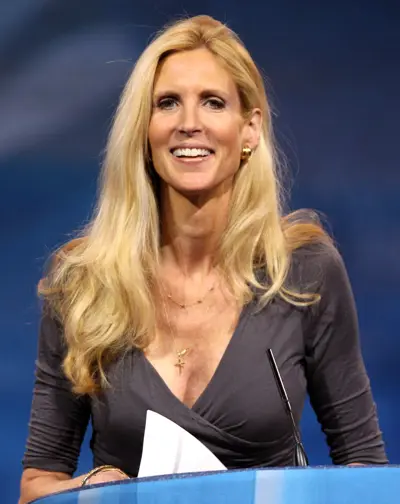
Ann Hart Coulter is an American conservative media pundit, best-selling author, syndicated columnist, and lawyer.
