Adolf Hitler Quotes
It [the Sudetenland] is the last territorial claim that I have to make in Europe.
Hitler, Adolf. The Speeches of Adolf Hitler, April 1922 – August 1939. Edited by Norman H. Baynes, vol. 2, Oxford University Press, 1942, p. 1508.


The reference to Munich was to the famous appeasement of Adolf Hitler and the Nazis by British Prime Minister Neville Chamberlain. See {585941}.

Leval was an appeaser and a collaborator with the Nazi’s. He led the government in name but the Germans really controlled the country. His actions killed tens of thousands of French men and women by turning them over to the Germans. After the Germans were defeated in WWII, Leval was shot as a traitor by the Free French forces.

The “fool” was Neville Chamberlain, 1869-1940, the British Prime Minister who refused to stand up to Hitler and instead negotiated a peace pact, returned home declaring that he had preserved peace. (See {585941}.) Then Hitler invaded more of Europe and WWII was begun. Ford was a Hitler admirer and pro-German (Hitler supported him for the American Presidency--{586988}—and awarded him a medal) but he thought that England had bungled the negotiations by sending someone who was very weak. In this sense his views were the same as most who were anti-Hitler.


In this case, the Speaker of the House attacked the President of his own party for being willing to conduct disarmament discussions with the Russians. He implied that the outcome could be the appeasement of the Russians just as British Prime Minister Neville Chamberlain appeased Hitler in 1938 in Munich, giving the German Fuhrer the “green light” to take over Europe. The Conservative Caucus went even further and explicitly called it “appeasement”. Reagan however always talked about military strength and power, and provided plenty of money for the military and weapons a few of which were boondoggles but he was a very cautious American president in authorizing military force. And he not only was willing to discuss arms control and reductions and enter into treaties for disarmament, much to the distress of the hawks of his own party. Few American Presidents have so well balanced the use of diplomacy with the threat of military force as well as Reagan.


She and her husband, like many of the "America Firsters", believed that Hitler should be allowed to overrun Europe and Russia.


Although Churchill, FDR, and a few other world leaders also recognized this reality, most people, even in America and Europe were not yet knowledgeable about the danger of Hitler and Nazi Germany. What is fascinating is that a theoretical scientists—one whose work had little to do with reality could be that perspicacious to identify major political trends. But Einstein was not only one of the world’s great scientific thinkers but he was a very sophisticated political and philosophical thinker.


This telegram was one of the more bizarre episodes leading up to WWII. The “solution” that Rothermore was praising was the German Army seizing and occupying a large part of Czechoslovakia – the Sudetenland -- in violation of the WWI Peace Treaty that Germany had signed. Further, Rothermere knew perfectly well that England and France were bound by treaty to come to the military aid of Czechoslovakia and war between Britain and Germany could break out at any moment. Yet he sent the telegram encouraging Hitler in his aggression. The Daily Mail, Rothermore’s very conservative newspaper supported English Fascist Oswald Mosley and wrote articles favorable to Mussolini and Hitler. There was a small but powerful part of English Aristocracy who were pro German and pro Fascist including the King, Edward, Duke of Windsor {584507} who was persuaded to abdicate and relegated to the Bahamas where his views were not so public. The Daily Mail catered to that part of the English Aristocracy.


1st Viscount Grey of Fallodon. He was advocating British entry into WWI in defense of the Neutrality of Belgium as was their treaty obligation.

In 1938 Germany had rearmed and resumed its aggressive designs of expansion. Hitler wanted the Sudetenland part of Czechoslovakia and threatened an invasion of that country. England had France had a treaty obligation to militarily support Czechoslovakia if it were attacked. British Prime minister Neville Chamberlain and the French were desperately trying to avoid war, not realizing that with Hitler, that position was the very thing that would bring on war. So they agreed to Hitler’s demand and allowed Czechoslovakia to be partitioned and the Sudetenland was annexed to Germany. This craven appeasement emboldened Hitler who then decided to conquer all of Europe as he had no serious opposition from France and England—the two powers that might have stopped him. (At the time, the French had a larger army than the Germans.)

Poland and most other European Governments and their people were very fearful of a strong Germany with WWII always present in their memories. However, at this time the Conservative German government had very passive policies with respect to the European Community and some German leadership and activism was thought necessary by many leaders of Europe. Germany was one of the strongest economies in Europe and without the WWII legacy of aggression would normally be expected to be more of a European leader.

See {633152} for more of the reasoning for this point. “Neocon” is a shortened form of “neoconservative”. At the time the neoconservatives were advocating use of military intervention in the Middle East. Munich was the German city in which British Prime Minister notoriously tried to appease Hitler and the Nazis. This led to WWII and has become the historical icon for appeasement of a powerful tyrant and the cost of such.


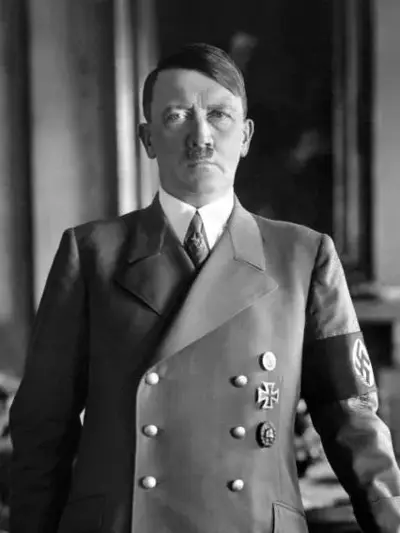
Adolf Hitler was an Austrian-born German politician who was the dictator of Germany from 1933 to 1945. He rose to power as the leader of the Nazi Party, becoming Chancellor in 1933 and then assuming the title of Führer und Reichskanzler in 1934. During his dictatorship from 1933 to 1945, he initiated World War II in Europe by invading Poland on 1 September 1939. He was closely involved in military operations throughout the war and was central to the perpetration of the Holocaust, the genocide of about 6 million Jews and millions of other victims.
