Andre Gide Quotes
It is essential to persuade the soldier that those he is being urged to massacre are bandits who do not deserve to live; before killing other good, decent fellows like himself, his gun would fall from his hands.
Gide, André. The Journals of André Gide, Volume IV: 1939-1949. Translated by Justin O'Brien, Alfred A. Knopf, 1951, p. 22.


The Hun were a very fierce, Asian people who under Attila, defeated the troops of the Roman Empire and sacked several Italian cities. They fought very intensely and terrorized their enemies. The Kaiser came under great criticism from other European powers from urging his soldiers to emulate vicious barbarians with no sense of Christian morality.


Description of the tactic of terrorism as employed by Attila the Hun. This is one of the first articulate descriptions of the motivation of terror tactics.

In 1856 Kansas was at war over slavery. Kansas was to enter the Union with the resident men voting to determine whether it would be a slavery state or a free state. At first pro-slavery forces sent men into Kansas to increase the pre-slavery vote. The abolitionist anti-slavery forces outside of Kansas did the same, and had more money to finance anti-slavery settlers. Soon the pro-slavery forces, realizing that they would be outnumbered turned to violence and began to intimidate abolitionist settlers to return from whence they came. Soon abolitionists were killed and the anti-slavery men retaliated. Soon real war broke out but terrorism was the modality on most attacks as the purpose of the pro-slavery men was to frighten the abolitionists—many of whom were religious pacifists—into leaving the state. Brown and some other abolitionists retaliated with terror of their own, but Brown was rabid. He and his sons, attacked 5 pro-slavery fighters at Pottawatomie Creek, but Brown personally hacked off their limbs with a broadsword and left the bodies to intimidate and terrorize many of the pro slavery people. Brown was such a fanatic that he, in this infamous quote, claimed that his killing and butchery was “justified under the circumstances.” The phrase “Bleeding Kansas” came from the violence and terrorism in this period.

He was leading the Gordon Highlanders of the British Army against the Boers during the Boer War. He was seriously wounded and could not go on himself with a charge he had ordered, However, waifing his sword he made this famous qutation. Particualrly noteorthy is the derrogatory terms which he used to describe the enemy--the Boers of South Africa. In many wars and cultures, one or more of the combatants, in order to overcome the avarage soldier's reluctance to kill an enemy, characterizes them as less than human. In this case, vermin, who were to be exterminated. There were two predominant groups of whites who came to South Africa, the English who were generally well-educated and were interested in trading with the exhisting inhabitants and investing in businesses using mostly native labot and the Boers. The latter were of Dutch and German origin, poor farmers with little or no land in the home country and little education. Their interest was to create a nation where they could own land to farm. And the lest expensive way for them to increase their farmland was to sieze it from the native Blacks and who were the major forces behind the racial discrimination which became apartheid. The British contolled the government and sought stability and as in most of the British Empire, they wanted English law to prevail including the rights of the Black natives. The Boers had left Europe for good and would thrive or not in Southern Africa. Proportiopnately, the English might have a career in South Africa or serve there for a few years. They were Englishmen in a foreign country. The Boers saw themselves as citizens of Southern Africa who were fighting the native Blacks for control of the land. The English legal system would not allow any of the land seizures and political discrimination that the Boers saw as existential for their survival in Africa. Soon, the Boers took more and more of the law into their own hands and saw English rule and dmination as inimical to their interests in Africa and they tried to create their own independent states in Southern Africa. That was the essense of the Boer Wars. Dick-Cunyngham was awarded the Victoria Cross, the highest military decoration of Great Britain, for his exploits in the Afghan War.


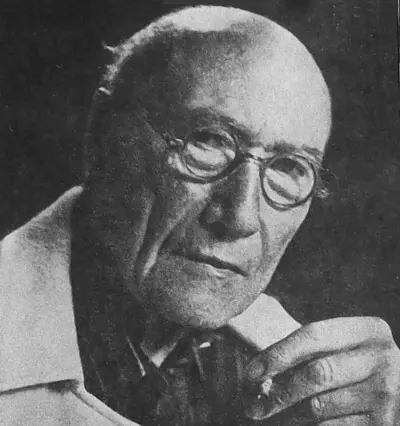
André Paul Guillaume Gide was a French author and winner of the Nobel Prize in Literature (in 1947). Gide's career ranged from its beginnings in the symbolist movement, to the advent of anticolonialism between the two World Wars. The author of more than fifty books, at the time of his death his obituary in The New York Times described him as "France's greatest contemporary man of letters" and "judged the greatest French writer of this century by the literary cognoscenti."
