Pierre Curie Quotes
It can even be thought that radium could become very dangerous in criminal hands, and here the question can be raised whether mankind benefits from knowing the secrets of Nature, whether it is ready to profit from it or whether this knowledge will not be harmful for it. The example of the discoveries of Nobel is characteristic, as powerful explosives have enabled man to do wonderful work. They are also a terrible means of destruction in the hands of great criminals who lead the peoples towards war. I am one of those who believe with Nobel that mankind will derive more good than harm from the new discoveries.
This problem is still with us. Nuclear proliferation, dirty radioactive bombs, and terrorism are potential down sides of radioactivity.
Pierre Curie, 1859-1906, French chemist and physicist, Winner with his wife Marie of the Nobel Prize, 'Radioactive Substances, Especially Radium', Nobel Lecture, June 6, 1905
Sourced by: Eigen's Political and Historical Quotations


He was writing about the impending First World War.


Einstein saw the war as madness but what distressed him most was that his friend and colleague, Fritz Haber, to help the war effort developed poison chlorine gas as a weapon which killed and maimed hundreds of thousands. He was a devoted pacifist thereafter. It took an even greater madman like Adolf Hitler and his Nazis to reach the mental point where he recommended to President Roosevelt that scientists develop an atomic bomb.
This declaration, drafted by Russell and Einstein two days before Einstein’s death was signed by a number of other prominent scientists.


One fascinating thing about this quotation is the date. It would be the next 150 years where the great scientific leaps would take place. There was no inkling of computers or nuclear weapons.

This was written over 2 decades before Dolly the sheep was first cloned. Since his call for a societal public discussion about cloning, there has been very little, but by the 21st century there had been just a few hasty, ill-informed, almost hysterical efforts to legislate on the subject.

At the time, surprising to most people now, the use of the atomic bomb was not an issue of controversy at all. There were no Congressman who questioned it, no newspapers which editorialized against the use of the bomb. There were not even any other counties which protested its use. The blessing of ending the war, even at the cost of less than 200,000 deaths seemed a clearly desirable tradeoff when compared with the many millions of deaths that would have occurred had the bomb not been used. As an example, the conventional bombing of Tokyo before the nuclear weapons were used killed as many Japanese as either Hiroshima or Nagasaki.


Bryan participated as a prosecutor in the infamous Scopes Trial in Tennessee where a school teacher was convicted of a crime for discussing the idea of evolution in a high school classroom. He had written this for his summary to the jury, but the summaries were dispensed with when it was obvious that Scopes would be convicted. He had admitted to breaking the law, but the law itself was on trial.


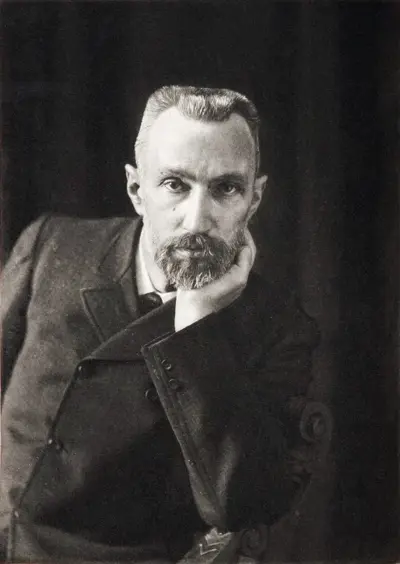
Pierre Curie was a French physicist, a pioneer in crystallography, magnetism, piezoelectricity, and radioactivity. In 1903, he received the Nobel Prize in Physics with his wife, Marie Curie (née Skłodowska), and Henri Becquerel, "in recognition of the extraordinary services they have rendered by their joint researches on the radiation phenomena discovered by Professor Henri Becquerel".
