Haile Selassie Quotes
modern civilization and the progress of science have greatly improved man's life and have brought comfort and ease in their trail. But civilization can serve man both for good as well as for evil purposes. Experience shows that it has invariably brought great dividends to those who use it for good purposes while it has always brought incalculable harm and damnation to those who use it for evil purposes
Haile Selassie, 1891-1975, Ethiopian Emperor, Interview in The Voice of Ethiopia (5 April 1948
Sourced by: Eigen's Political and Historical Quotations


This was a radical speech for the time, suggesting reforms that had been unthinkable to most Turks. Although it is not prohibited by the Koran and early Islamic artists made some of the greatest paintings and depictions of people, fundamentalists gained control of Islam and interpreted any statue as an idol that could be worshipped and this generalized to Islamic art in general where people ceased to be depicted and even animal depictions were rare. Muslim art developed incredible geometric intricacy but tended not to depict anything that is real. This extended to photography and illustrations in books including textbooks. At the same time, not unlike some Christian and Jewish Fundamentalists, the Muslim fundamentalists opposed science and the teaching thereof on the grounds that all authentic knowledge was in the Koran and anything else was not only false but also heretical. So this speech was a type of “declaration of war” against the established religious order and culture.


By “arts” Jefferson meant the mechanical arts—inventions and engineering. Jefferson Extrapolated the science and technology progress at the time to the future in a way that few others did at that time.


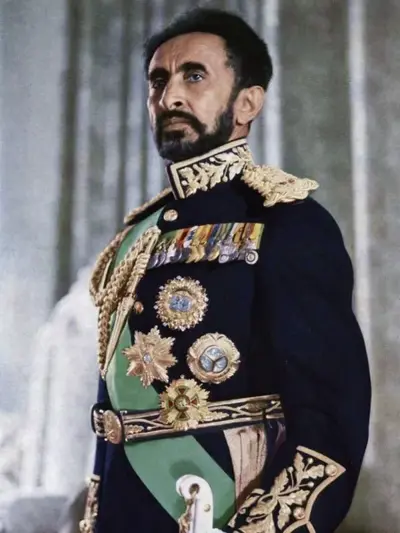
Haile Selassie I was the Emperor of Ethiopia from 1930 to 1974. Prior to his coronation, he had been the Regent Plenipotentiary of Ethiopia from 1916. He is a defining figure in modern Ethiopian history. He was a member of the Solomonic dynasty who traced his lineage to Emperor Menelik I.
