Tariq Ramadan Quotes
Islam has no problem with women, but Muslims do clearly appear to have serious problems with them
Ramadan, Tariq. What I Believe. Oxford University Press, 2009.


Sharie is the Islamic code of law based on the Koran which is so brutal that they would stone a woman to death who had illicit sex or kill someone who wanted to change his religion.

The burqa wearing practice was outlawed by French Law.


Dr. Saadawi was fired from her government post for revealing the status of women in the country. She was also actually arrested and jailed as well for impairing national “values.” See .{586709}.

Some modern versions of the Koran annotate the “beating” injunction and argue that this should only be used as a last resort. This is an example of socially unacceptable anachronisms that are found in the scripture of most older religions. All but the radical fundamentalists do not take these passages literally.

The Hijra was the spread of Islam after The Prophet organized the first Muslims. Islamic reformers have been trying to improve the legal and cultural position of women in Islamic Societies ever since with little success, even in modern times. The notable exception was the Turkish Revolution led by Ataturk. He was familiar with Aga Kahn arguments for reform and put the force of law behind them. See {444998}.


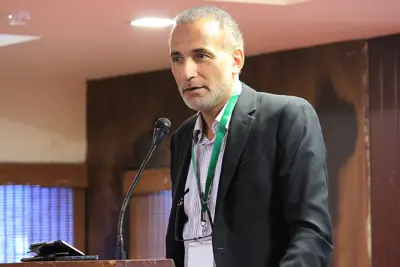
Tariq Ramadan is a Swiss Muslim academic, philosopher, and writer. He was a professor of contemporary Islamic studies at St Antony's College, Oxford and the Faculty of Theology and Religion, University of Oxford, but as of 2018 is taking an agreed leave of absence. He is a visiting professor at the Faculty of Islamic Studies at Hamad Bin Khalifa University in Qatar, and the Université Mundiapolis in Morocco. He is also a senior research fellow at Doshisha University in Japan. He is the director of the Research Centre of Islamic Legislation and Ethics (CILE), based in Doha. He is a member of the UK Foreign Office Advisory Group on Freedom of Religion or Belief. He was elected by Time magazine in 2000 as one of the seven religious innovators of the 21st century and in 2004 as one of the 100 most influential people in the world and by Foreign Policy readers (2005, 2006, 2008–2010, 2012–2015) as one of the top 100 most influential thinkers in the world and Global Thinkers. Ramadan describes himself as a "Salafi reformist".
