Sayyid Qutb Quotes
Islam cannot accept or agree to a situation which is half-Islam and half-Jahiliyya [separated from God].
Qutb, Sayyid. Milestones. American Trust Publications, 1990.


Here Khomeini takes the classic Islamic view of the Koran that leaders should be obeyed unless they do not follow Islam. To the leaders of Islamic nations, this means that even if the state is not a theocracy, the Muslim clergy has the final say as to whether a ruler may justly remain in power since they are the ones who determine if a ruler is properly following Islam.

Legal Religious Ruling. This is an example of a source of tension between some Muslims and others. Non-Muslims are required to have a Muslim Education in Muslim countries, but they insist that any required Christian or secular education in a non Muslim country is anti-Islamic.


Theological & Legal Expert. The Sunnah, like the Koran, has statements of the Prophet, Mohammad. A fatwa is a religious legal ruling. This particular Fatwa shows the great difference between the Islamic State and a Republic or Democracy. In the latter forms, any religious practices must be consistent with the Constitution. Even though blasphemy might be prohibited by a religion, the United States Constitution for example protects anyone’s right to be blasphemous. In the Islamic system any constitution or law is subservient to and must be consistent with, the sayings of the Prophet Muhammad. In that sense, unless the Muslim populated nation is secular like Turkey, then the governments are partial or total theocracies.

This phrase has been used by fundamentalists to justify forced conversion and the imposition of religious law—Sharia—on believers and unbelievers alike. The logic is that if God says believing orthodox Mosems are the best, that is what he wants for all. And therefore by forcing others to be orthodox and of the faith, one is doing God’s bidding. See Husain Haqqani, “Islam’s Medeval Outposts,” Foreign Policy November/December, 2002.


English Muslim terrorist organization. This quotation illustrates what is perhaps the greatest difference between Muslims and most members of other religions. Most others think of their personal identity in national terms and then occupational, religious and racial. A Christian might say ‘I am a French Attorney who is a Christian’; a Buddhist , ‘I am a Cambodian Buddhist. But most Muslims would say, ’I am a Muslim from France’ or a ‘Follower of Islam residing in Lebanon.
This is not terribly different however from Christians and Jews selectively quoting the Bible.

Gabriel exaggerates in the sense that while the quotation is correct for many Muslims, it is by no means true of all. Iran for example is an Islamic theocracy, but Turkey is a 99 percent Muslim nation which is totally secular and in some ways is much more restrictive of Islamic teaching and practice than most secular democracies. The fundamentalist Muslim view of the state and religion is essentially the same as the ultra orthodox Jews and Christians. It is true that a greater proportion of Muslims believe in the merging of civil and religious law than Jews and Christians, but by no means all. The non Arab Muslims are much less likely to see the unity of state and religion.
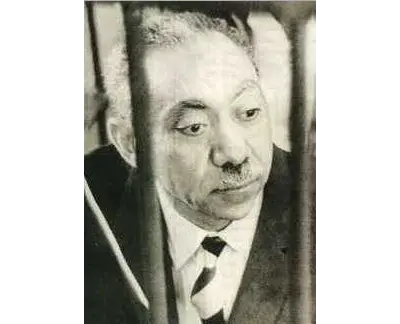
Sayyid Ibrahim Husayn Shadhili Qutb, known popularly as Sayyid Qutb, was an Egyptian author, educator, revolutionary, Jihadist ideologue, poet, and a leading member of the Egyptian Muslim Brotherhood in the 1950s and 1960s. In 1966, he was convicted of plotting the assassination of Egyptian President Gamal Abdel Nasser and was executed by hanging. Sayyid Qutb is considered as "the Father of Salafi-Jihadism", the religio-political doctrine that underpins the ideological roots of Global Jihadist organisations such as Al Qaeda and Daesh.
