Robert Byrd Quotes
In this Congress, we are not obliged to be bound by the dead hand of the past Congress
Robert Byrd, 1917-2010, U. S. Congressman & U. S. Senator (Democrat, WV), Senate Majority & Minority Leader, Arguing that each Congress is entitled to establish its own rules without following the rules adopted by the previous Congress, Quoted by Senator Lamar Alexander, Senate Debate, January 5, 2011
Sourced by: Eigen's Political and Historical Quotations

If a party controls one of the two houses of Congress, they can block any legislation. But governing involves passing legislation, and in our bi-cameral Congress, control of one house is not sufficient to pass legislation.


He and Thomas Jefferson were the two most vocal propononents of this view amongst the Founding Fathers.

When requested to have the assembly remove items in the proposed constitution at the last minute:

The U. S. Senate had deteriorated to the point where Senators were only working 3 days per week—Tuesday through Thursday. The Senators would spend the other 4 days in their home states—usually raising money for the next election where millions of dollars will be needed.

In 2007 the Republicans, who were in the minority, began to use the filibuster to a degree that it had never been used. Within the single year of 2007 Republican’s filibustered 62 times, doubling the highest rate that had occurred before. A small minority of senators were able to block legislation that easily passed the House and was supported by the majority of senators and in some cases supported by the overwhelming majority of the American Public.

Despite having passed the House and a majority of the Senate favoring McCain’s bill, a filibuster was led by a few holdouts from his own party. Patiently, McCain assembled sufficient Senate support to break the filibuster.

The senator had broken with his own party on the issue of slavery in the territories.

The Constitution sets the majority of each house as a quorum in order to conduct any business. Minorities, in order to obstruct proceedings, would often refuse to answer their names when a quorum call would made even though they were present in the House, Therefore they claimed they could not be counted towards a quorum. In those days there were always absences due to illness, transportation, family emergencies and the like. So the majority had to have most of its members on the floor at all times if the minority wanted too obstruct. The minority claimed it was their right under the Constitution, Reed said that interpreting the Constitution that way was tantamount to suicide for the House. He then changed the rule, and simply counted as present any member who was observed to be present, whether he answered a quorum call or not.


Commenting on the legal defense of executive actions by the Obama Administration and how it applies to contesting similar executive actions by Donald Trump…


The Czar, a total autocrat, was out of touch with most of the civilized world. Under much pressure from his advisors who realized that there was much unhappiness with an autocracy, the Czar made this reform which seemed a major concession and was very much welcomed by the people. However, it had relatively little practical effect. The Duma could not make laws, they could only ratify those made by the Czar and his ministers. However, few members of the Duma were willing to vote against a measure that the Czar wanted. It had no practical effect on improving the standard of living and the economic development of a backward empire.


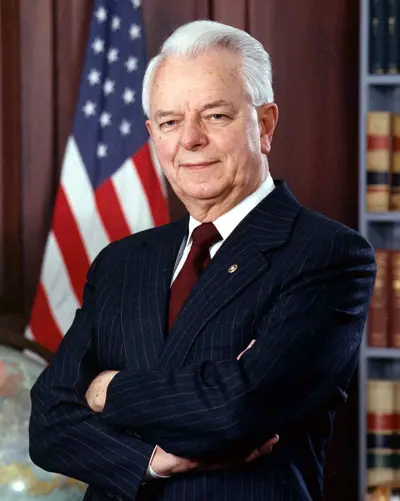
Robert Carlyle Byrd was an American politician who served as a United States Senator from West Virginia for over 51 years, from 1959 until his death in 2010. A member of the Democratic Party, Byrd also served as a U.S. Representative for six years, from 1953 until 1959. He remains the longest-serving U.S. Senator in history; he was the longest-serving member in the history of the United States Congress until surpassed by Representative John Dingell of Michigan. He was the last remaining member of the U.S. Senate to have served during the presidency of Dwight Eisenhower, and he was the last remaining member of Congress to have served during the presidency of Harry S. Truman. Byrd is also the only West Virginian to have served in both chambers of the state legislature and both chambers of Congress.
