Ibn Khaldun Quotes
In the Muslim community, the holy war is a religious duty, because of the universalism of the Moslem mission and the obligation to convert everybody to Islam either by persuasion or by force .... The other religious groups did not have a universal mission, and the holy war was not a religious duty for them, save only for purpose of defense.... Islam is under obligation to gain power over other nations
He was one of the world’s greatest polymaths who among his other accomplishments was the “Father of Sociology” and was the leading Islamic intellectual of his era. This is a very important quotation because ibn Khalidun was such a monumental and respected Islamic intellect. He confirms the history that Islam was spread both by persuasion and by force. He also makes the distinction between Islam and other religions regarding war, Finally, the last sentence characterizes Islam as an aggressive, expansionist force that is a potential danger to all non-Muslim states.
Ibn Khaldun, 1332-1406, Tunisian Islamic astronomer, economist, historian, Islamic jurist, Islamic lawyer, Islamic scholar, Islamic theologian, mathematician, military strategist, nutritionist, philosopher, social scientist and statesman, The Muqudimmah: An Introduction to History
Sourced by: Eigen's Political and Historical Quotations


This particular quotation is very important. Khomeini was probably the most influential Muslim in the 20th Century. The fact that he wrote this in 1942—before there was an Israel as an enemy—shows how deep seated the requirement for world conquest is. To the Nazi’s world conquest was a justifiable goal. To Khomeini and his many followers, it is a religious obligation and duty and thus is every more dangerous. Extreme anti Muslims justify the attempted expulsion of Muslim immigrants on the grounds that they are a fifth column whose loyalty is and will be to the religion which will attempt to conquer their country. It gives Islamaphobia a veneer of respectability.

Religious obligation of Islam requires all Muslims to try and convert all others. However that is not different from some of the Christian, fundamentalist religions where attempted conversion of non-believers is a duty. However, where many in the Islamic world see that obligation as a peaceful, nonviolent, effort to persuade others to accept Islam, there are many others who believe that Jihad should impose Islamic law—Sharia—upon the world and the use of force and violence is not only acceptable but is necessary and desirable to achieve their objection.

See {586039} for a quotation that goes further and seeks to punish and humiliate the non believers. This sura is often used by those wishing to illustrate the intolerance of Islam—especially of other religions. They fail to put this into the context of the Old Testament which proscribed death for heretics or the history of Christianity regarding the murder of nonbelievers. The difference is however, that a very small proportion of Jews or Christians today believe in following Biblical instructions in this respect while the proportion of Muslims who believe in the literal interpretation of scripture on these points is much larger. However there are Islamic modernists and moderates throughout the world who reject this notion of warring on all other religions and there is a struggle going on within Islam itself.


This is the philosophical root of Islamic Fundamentalist terrorism. If this principle is accepted, then it is very easy to rationalize anything to change a situation where Islam and Islamic law does not control anywhere
See {586041} for a Koranic quotation that urges world domination by Islam. In this quotation, The Prophet was talking to his followers at a time when Islam was not even a dominant religion in Arabia. And war was the way in which tribes, groups, and religions and sects, established themselves and grew. Although there are other Koranic passages which tell the faithful that people can only legitimately come to Islam through individual commitment and willingly, this passage not only seems to contradict that but also reflects a desire to punish and disgrace “non-believing” groups. This vengeance motif is also contradictory to much else of the Koran which generally preaches love, forgiveness, and understanding. However, there are contradictions and intellectual inconsistencies within the Koran just as there are within the Old and New Testaments.
In the early stages of Islam, Muhammad had hoped to convert the Jews and others on the Arabian Peninsula. When they refused to be converted, he warred against them usually killing the men, and taking the women and children as slaves. The result was that non-believing tribes were “cleansed” from the Arabian Peninsula. The Muslims at the time preferred children as slaves. For then they could convert the children against their will. Adults in Islam must accept Islam in order to convert. Children are regarded as having no such maturity of decision making and therefore opposition to conversion may be ignored and they may be forced. Critics of Islam and those who argue that Islam is at odds with all other religions point to this quotation. They claim that it is the only religion whose founder and fundamental scriptures demand war against others for no other reason than that they believe in a different religion. The Catholic Church during the Crusades and the Inquisition had a similar philosophy as did Christian missionaries colonizing Africa later. One difference is that most Christians today repudiate the doctrine as against the true spirit and teachings of Christ and view it as historical error, while very few modern Muslims repudiate this quotation of the Prophet.

At the time the Mongols were the “infidels” who dominated the area and the various Islamic sects were at odds with each other. According to him, belief is the highest duty and fighting for the religion was next in importance.


Richard Southwell Bourke. Victoria was then Queen. The role of the Islamic religion in terms of violence, terrorism & rebellion is not uniquely a question of the 21st century. The 19th Century saw much Islamic fundamentalist violence in India and other Islamic Colonies—much more than from other religious groups in similar colonial status. Opinion was divided between those who saw Islam—especially the Wahabi sect—as inciting violence per se. Mayo assigned one of his administrators to do a study of the issue. See {616924} for the study of William Wilson Hunter. Ironically, Lord Mayo was stabbed to death in a terrorist attack on him personally in 1872.


His views are a mix of modernism and fundamentalism. He favors democracy and elections but also favored the Taliban destroying the great ancient Buddha statues when he was called an idol worshipper for urging the preservation of art. His ignorance of modern technology Is illustrated by his complaint that the Arab nations do not even “produce a single nail” for modern cars. The reality is that there are no more nails in modern cars.

Professor Tibi and others have also pointed out that with this definition within Islam, there is no possible justification for a non-Muslim state to war against a Muslim state even of the non-Muslim state was attacked first. However, note that most educated Muslims, like Dr, Tibi, do not hold this preposterous position. It does however illustrate why some Muslims can be outraged when Israel fights back against the thousands of rockets fired from Gaza. To them the 7000 rocket firing was a just war to make Israel a Muslim territory, but no retaliation by non-Muslims can be just.
Collection of Spoken Words of the Prophet
Most modern Islamic clerics were and are shocked at this interpretation of Islam,
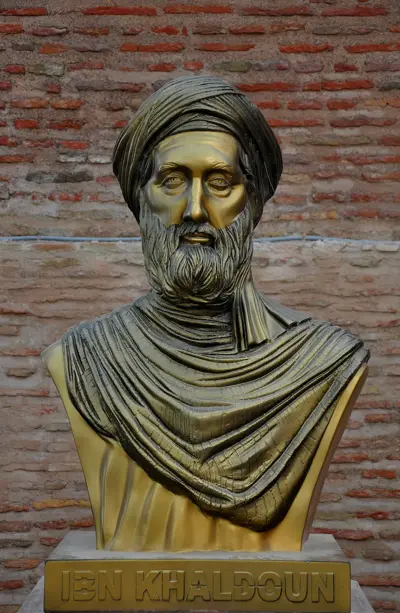
Ibn Khaldun was an Arab sociologist, philosopher and historian who has been described as the founder of the modern disciplines of historiography, sociology, economics, and demography. Niccolò Machiavelli of the Renaissance and the 19th-century European scholars widely acknowledged the significance of his works and considered Ibn Khaldun to be one of the greatest philosophers of the Middle Ages.
