Greg Grandin Quotes
In Texas, the rangers were established on an ad hoc basis in the 1820s to protect the settlers making inroads into Spanish borderlands. Soon, Mexicans and Mexican Americans replaced Native Americans as the prime target of ranger repression.
Grandin, Greg. The End of the Myth: From the Frontier to the Border Wall in the Mind of America. Metropolitan Books, 2019.


In 1844 the United States had designs on the Oregon territory north of the Columbia River which was claimed by England as being a part of Canada. American politicians were split with the administration leaning towards yielding America's claim. Others urged a strategy which was later emulated by Israel in its settlements of occupied territory.


Large wagon trains of settlers crossed the content on their way to the Oregon Territory. The Sioux Indians whose land the wagon trains had to pass through often attacked the wagon trains in a vain effort to discourage others from passing through the area. The Sioux believed that the large wagon trains frightened the buffalo away, which was probably not a significant factor in the diminishing of the buffalo herds. The Indians and white hunters both over-hunted the buffalo which became few in numbers. With modern wildlife management Buffalo are not only back but are plentiful and being raised for their lean meat which has become a delicacy.

He was part of the Congressional Delegation that had been appointed to welcome the newly elected first President George Washington to New York City, then the first capitol of the nation. The delegation met Washington on the New Jersey shore of the Hudson River and escorted him with a large flotilla of official and unofficial boats across the Hudson River to the Manhattan shoreline where this huge crowd had gathered. The tremendous crowd worried some of the Congress who thought there might be too much respect and obedience to the President—that he might be viewed as a monarch or worse, view himself as one. The authority and respect paid to the president was in political dispute for the first three presidential terms until Thomas Jefferson defeated John Adams and the Federalists.


In March of 1814 Jackson led a force to track down the Red Sticks. When they did so at Horseshoe Bend. Jackson made a frontal assault on the Red Stick Breastworks which might have gone badly had not a cotangent of Cherokee Indians—also concerned about the Red Sticks attack on their settlements, assaulted the Red Sticks from the rear. The Red Sticks, caught between the two uncoordinated attackers, lost over 900 men and the battle which then decided the war. In this Battle, Junaluska, a Cherokee, saved Jackson’s life. Years later he would not differentiate between the different Indian peoples and contrary to a Supreme Court order, forced the Cherokee from their settled farms and ranches and moved them to the Oklahoma Territory.

Carson was one of the few Indian Agents who spent every penny of his budget on the Indians as opposed to himself. He was married to an Indian woman and was close enough to many Indians that he understood their resentment whenever they came into a town. They were treated terribly and while most of them were literally starving, seeing the white opulence produced resentment.

Wayne played so many parts depicting whites in the process of expanding Westward that many people saw him as an expert on the history of the Westward Expansion. He did not comment on the whites who then kept huge ranches “selfishly” for themselves or those who selfishly would not share the mineral rich land that they had taken with anyone including the original Indian owners. So in this view, the Indians should have not been capitalists but they should have been socialists and shared their resources.


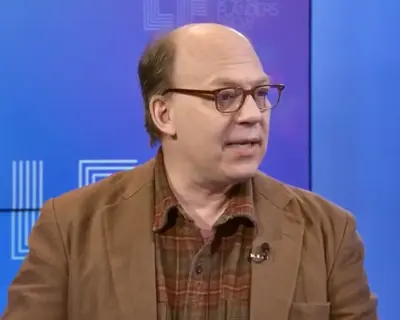
Greg Grandin (born 1962) is a professor of history at Yale University. He previously taught at New York University. He is author of a number of books, including Fordlândia: The Rise and Fall of Henry Ford's Forgotten Jungle City, which was a finalist for the Pulitzer Prize for History, as well as for the National Book Award and a National Book Critics Circle Award. A more recent book, entitled, Who Is Rigoberta Menchú?, focuses on the treatment of the Guatemalan Nobel Peace Prize winner. His 2014 book, The Empire of Necessity: Slavery, Freedom, and Deception in the New World, is a study of the factual basis for the novella Benito Cereno by Herman Melville.
