Miriam Makeba Quotes
In New York I heard A Piece of Ground, written by a white South African, Jeremy Taylor. I modified it a little and sang it myself. That song is very special to me because it deals with the land question in southern Africa. We were dispossessed of our land.
Makeba, Miriam, and Nomsa Mwamuka. Makeba: The Miriam Makeba Story. STE Publishers, 2004, p. 112.

The line, like many in good poetry, has several levels of meaning. The most obvious is that we had explored and conquered the land, before we became a nation.


The central Indian policy problem for Jefferson’s Administration was the fact that most Indians hunted for subsistence and the amount of land needed to support a hunting society was per capita much greater than an agricultural and especially an industrial one. Jefferson had no personal animosity against the Indians as many in his day did. But he perceived the need to obtain Indian lands for white agricultural use.


Wayne played so many parts depicting whites in the process of expanding Westward that many people saw him as an expert on the history of the Westward Expansion. He did not comment on the whites who then kept huge ranches “selfishly” for themselves or those who selfishly would not share the mineral rich land that they had taken with anyone including the original Indian owners. So in this view, the Indians should have not been capitalists but they should have been socialists and shared their resources.

This is an important quotations for two reasons. First, one of the white Europan myths in the colonial era was that the Native America had not concept of land ownership and title. This quotation clearly refutes that/ Second, this shows that some Europeans coming to the new world opposed the view that the white Christians and a moral right to the Native American “heathen” land. A few like Williams did not.

If the land to be redistributed is divided amongst the majority population, each parcel would be too small to make any difference in any recipient’s life. For efficient agriculture there must be large land holdings. The colonial, stolen land history is valid for most former colonies, however, in Southern Africa, the situation was more complicated. When the whites landed at Capetown in the South, they moved North “stealing” land as they went. However, in Central Africa, Shaka and his Zulus were also a colonial power, and they moved South “stealing” land from the indigenous Blacks as they went. Eventually, the two Colonial Powers—the whites and the Black Zulus—clashed and the Zulu Wars ensued. So all of the land in Zimbabwe and South Aftica was stolen from the Blacks—except about half was stolen by Blacks. After the Zulu Wars, the victorious whites ended up “stealing” land from the Black Zulus that had been stolen by them from other Blacks. Also although the English were the official colonial power, the Dutch “Afrikaners” were a powerful subculture which was dominant on many parts of South Africa and especially at the frontier and they did most of the land stealing. The ethnic English were the businessmen and the city dwellers who actually ruled that Blacks were citizens with rights and slowedmdown some of the land stealing. There is no more complicated ethnic history in the world.


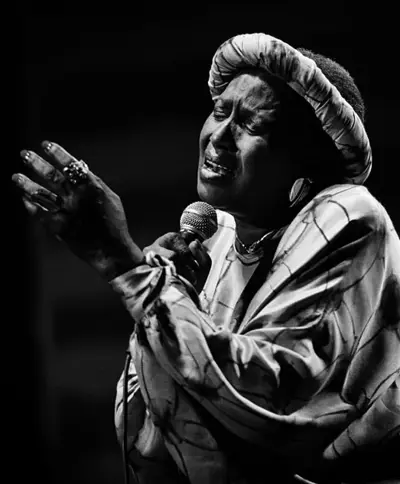
Zenzile Miriam Makeba, nicknamed Mama Africa, was a South African singer, songwriter, actress, United Nations goodwill ambassador, and civil rights activist. Associated with musical genres including Afropop, jazz, and world music, she was an advocate against apartheid and white-minority government in South Africa.
