Sitting Bull Quotes
If I agree to dispose of any part of our land to the white people I would feel guilty of taking food away from our children's mouths, and I do not wish to be that mean.
Utley, Robert M. The Lance and the Shield: The Life and Times of Sitting Bull. Henry Holt and Company, 1993, p. 273.


This is an important quotations for two reasons. First, one of the white Europan myths in the colonial era was that the Native America had not concept of land ownership and title. This quotation clearly refutes that/ Second, this shows that some Europeans coming to the new world opposed the view that the white Christians and a moral right to the Native American “heathen” land. A few like Williams did not.


The line, like many in good poetry, has several levels of meaning. The most obvious is that we had explored and conquered the land, before we became a nation.

The century to which he was referring was the 19th century---1800-1899.

Wayne played so many parts depicting whites in the process of expanding Westward that many people saw him as an expert on the history of the Westward Expansion. He did not comment on the whites who then kept huge ranches “selfishly” for themselves or those who selfishly would not share the mineral rich land that they had taken with anyone including the original Indian owners. So in this view, the Indians should have not been capitalists but they should have been socialists and shared their resources.


This quotation is the most hypocritical statements made by any President in his Inaugural Address. Jackson would not only flip flop on this principle and force the Indians (Cherokee and the Trail of Tears) to remove from their traditional lands in the East, but the Federal Government by Treaty was obligated to guarantee the sovereignty of the Cherokee land. What even made Jackson’s actions worse, was that the Cherokee had won their case before the Supreme Court, and Jackson became the only President in American history to refuse to enforce a Supreme Court decision that the Cherokee were entitled to their traditional land.


The early Zionists had an understanding of how they were then perceived by the Arabs who had been living in land that was to become Israel. Like most other parts of the world, the land of Israel has been conquered and reconquered over the years. The area had been a Jewish kingdom in the immediate centuries before the birth of Christ. They had conquered it from the tribes that had conquered it from the Egyptians who had also conquered it. Then the Romans conquered. After that there were Muslims, Christians, the Ottoman Empire, the British and finally Israel was formed. Throughout this entire history, both Arabs and Jews had lived on the land along with and under the authority of whoever was the latest conqueror. In the hundreds of years before the establishment of the state of Israel, the Arabs had been in the majority. The 20th century saw a large influx of Jews who immigrated, purchased land and settled. There had been low level conflict as the Arabs became concerned that with the immigration


The central Indian policy problem for Jefferson’s Administration was the fact that most Indians hunted for subsistence and the amount of land needed to support a hunting society was per capita much greater than an agricultural and especially an industrial one. Jefferson had no personal animosity against the Indians as many in his day did. But he perceived the need to obtain Indian lands for white agricultural use.


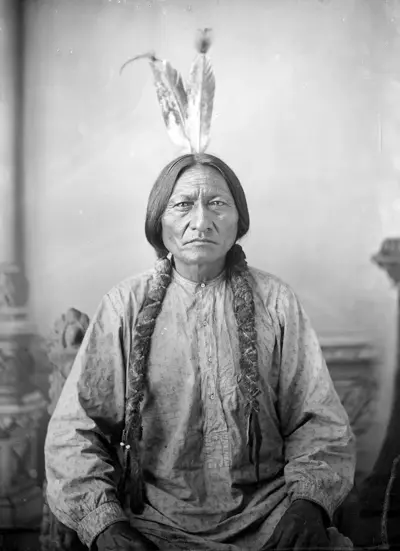
Sitting Bull was a Hunkpapa Lakota leader who led his people during years of resistance against United States government policies. He was killed by Indian agency police on the Standing Rock Indian Reservation during an attempt to arrest him, at a time when authorities feared that he would join the Ghost Dance movement.
