Brigham Young Quotes
If you want to know what to do with a thief that you may find stealing, I say kill him on the spot, and never suffer him to commit another iniquity. That is what I expect I shall do, though never, in the days of my life, have I hurt a man with the palm of my hand. I never have hurt any person any other way except with this unruly member, my tongue. Notwithstanding this, if I caught a man stealing on my premises I should be very apt to send him straight home, and that is what I wish every man to do, to put a stop to that abominable practice in the midst of this people. I know this appears hard, and throws a cold chill over our revered traditions received by early education. I had a great many such feelings to contend with myself, and was as much of a sectarian in my notions as any other man, and as mild, perhaps, in my natural disposition, but I have trained myself to measure things by the line of justice, to estimate them by the rule of equity and truth, and not by the false tradition of the fathers, or the sympathies of the natural mind. If you will cause all those whom you know to be thieves, to be placed in a line before the mouth of one of our largest cannon, well loaded with chain shot, I will prove by my works whether I can mete out justice to such persons, or not. I would consider it just as much my duty to do that, as to baptize a man for the remission of his sins. That is a short discourse on thieves, I acknowledge, but I tell you the truth as it is in my heart.
Brigham's remark was made in 1853—the Saints were in the midst of a serious struggle for subsistence in the Salt Lake Valley. Famine was a serious threat in these years and those who thieved from their neighbors under such conditions put others' well-being and even lives at risk. The frontier was known for lawless behavior among some, far from military or police power. Under these conditions, thievery could well result in the suffering and death of victims and others in their communities—hence Young’s determination to stamp it out.
Brigham Young, “Journal of Discourses,” vol. 1, pp.108-9.


He was one of the most articulate advocates for capital punishment.

Johnson was Vice President at the time. What he did not realize at the time was that one of the plotters was supposed to have killed him at the same time as the others, but the assassin got cold feet at the last minute and never entered Johnson’s house.


Kennedy, the father of JFK, had been one of the sleaziest of the stock market manipulators in the country. Prior to 1934 the Republican Hoover philosophy had prevailed letting the market regulate itself. But the practices of many of the Wall Street leaders were by modern standards outright thievery.FDR created the first Commission to regulate publicly traded stock transactions and schemes. He made a shrewd pick with Kennedy who was very egotistical and ambitious for power and recognition for Kennedy not only was an accomplished master at the skullduggery of the day, but he had no loyalty to the wealthy brokerage and financial leadership class as Kennedy was a Roman Catholic and at the time Catholics were never really accepted by upper class Protestant society. He turned out to be not only the first SEC Chairman but the one who demonstrated the efficacy of such regulation. He was then rewarded with the Ambassadorship to England the plum diplomatic assignment of the country.


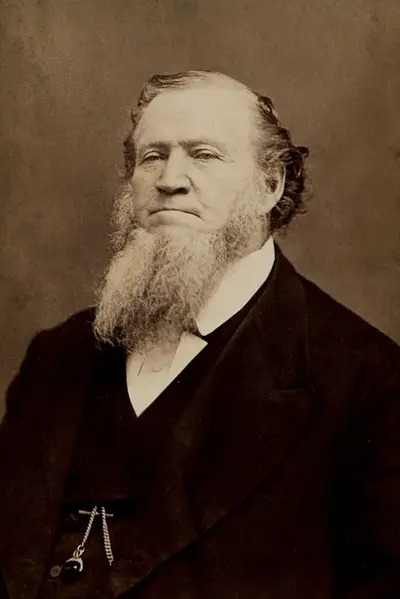
Brigham Young was an American religious leader, politician, and settler. He was the second president of The Church of Jesus Christ of Latter-day Saints (LDS Church) from 1847 until his death in 1877. He founded Salt Lake City and served as the first governor of the Utah Territory. Young also led the foundings of the precursors to the University of Utah and Brigham Young University.
