Saul Alinsky Quotes
If you have a vast organization, parade it before the enemy, openly show your power. If your organization is small, do what Gideon did: conceal the members in the dark but raise a clamor that will make the listener believe that your organization numbers many more that it does. If your organization is too tiny even for noise, stink up the place.
Saul Alinsky, 1909-{19972}, Community Organizer, Quoted in Wikipedia, April 25, 2005
Sourced by: Eigen's Political and Historical Quotations


After the report was produced someone had handwritten “Draft” on it. The technique of using government agents to spread disinformation to Americans has always been very controversial. The NYPD claims that despite this report, it is the policy of the department not to allow officers to disseminate disinformation. See {589484}. He did not say that civilian agents or paid informants did not do it for the department.


The quotation was given by Defense Secretary Donald Rumsfeld just prior to the war with Iraq, 2003.

The general had reported to the Czar that he had peacefully dissipated a protesting mob without firing a shot. The Czar felt that the absence of shooting and killing protesters would simply encourage more protests. See {613675}.


Lowery was one of the senior Black leaders in the civil rights movement of the late 1950s and early 1960s. In this interview, he was describing the atmosphere in Mobile, Alabama. Clergy of most faiths were active in the Civil Rights Movement in the South with the exception of the Roman Catholic Church which was very institutionally conservative. The Catholic leaders had a problem in that Catholics had been heavily discriminated against in early America and this prejudice was heaviest in the South in the 20th century. They feared that Catholic Activism against the status quo would create more problems for Catholics so they were not very helpful or supportive. This was NOT true for Catholics in general. Many individual Roman Catholics marched in the demonstrations, and some Catholic clergy from outside of the South came to the Southern protests and demonstrations. In the 20th century, the Catholic Church was divided between social activist reformers and in some cases revolutionists and the conservative wing of the Church who had supported the status quo.

This quotation was documented by an FBI illegal wiretap of King and his associates. The illegal wiretap had been insisted upon by FBI Director J. Edgar Hoover who was a racist and somewhat of a paranoid about communists. However, Attorney General, Robert F. Kennedy personally approved the illegal wiretap.

She was on a trip to Staten Island of New York City. It is a very small borough and whereas the rest of New York City has always been Democratic Supporters, Staten Island has usually supported the Republican Party, and to get there, they had to drive through Wall Street where the President and Mrs. Roosevelt were considered communists by many people. She appeared in public even more than the President who was limited by his paralysis. And she was used to the cheers and the boos and insults. This passage is typical of her attitude. Most first ladies find the boos and name calling very disconcerting, but not Mrs. Roosevelt.


His home was right in the midst of the major riot area. The government had just instituted the draft to provide soldiers for the Civil War. The rich could avoid the draft by paying a modest fee. The Irish of New York were at just slightly above the Negro in the New York Socioeconomic scale and the two groups competed for the low skilled jobs. Many Irish felt that they were being forced to fight to free the Southern Negroes who when free would come to New York and compete for their jobs. They rioted and killed over 100 Blacks.

Earlier, a virtually all white police force in nearby 67% Black Ferguson, had shot an unarmed black young man who was 20 feet away with his hands up, 7 times killing him and then leaving the body uncovered on the street for over 4 hours. Many people of all races began to peacefully demonstrate in Ferguson and were met with military assault weapons pointed at them and military armored vehicles, with the police illegally (as later determined by the courts) were interfering with the right to protest. The demonstrations turned to riots and there was looting and arson of business establishments. The demonstrations started to spread to nearby St. Louis and other cities as the news spread. While the Ferguson officials had behaved so badly and stupidly, the St. Louis mayor exhibited democratic leadership that was an example for others. Slay was then a 4 term mayor, being reelected more than any other mayor in St. Louis history, and was one of the outstanding politicians in America.

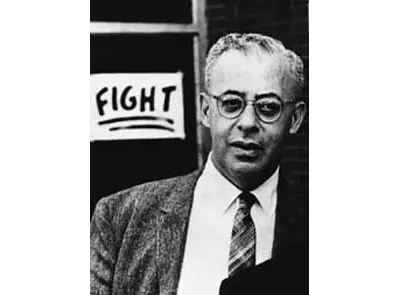
- Born: January 30, 1909
- Died: June 12, 1972
- Nationality: American
- Profession: Community Organizer, Writer, Political Activist
Saul David Alinsky was an American community activist and political theorist. His work through the Chicago-based Industrial Areas Foundation helping poor communities organize to press demands upon landlords, politicians and business leaders won him national recognition and notoriety. Responding to the impatience of a New Left generation of activists in the 1960s, in his widely cited Rules for Radicals: A Pragmatic Primer (1971) Alinsky defended the arts both of confrontation and of compromise involved in community organizing as keys to the struggle for social justice.
