George C. Marshall Quotes
I was very careful to send Mr. Roosevelt every few days a statement of our casualties. I tried to keep before him all the time the casualty results because you get hardened to these things and you have to be very careful to keep them always in the forefront of your mind.
Marshall, George C. George C. Marshall: Interviews and Reminiscences for Forrest C. Pogue. Edited by Larry I. Bland, George C. Marshall Research Foundation, 1991, p. 411.


The Congress had applauded his message vigorously.

The only soldier ever so honored


This audacious general and Queen of one of the Roman Provinces conquered most of the area including Egypt. Then she declared her independence from the Roman Empire itself. A master of multilateral coalition leading, she was able to attract nearby provinces to join her. The Roman Emperor Aurelian himself set out to subjugate Zenobia—the Roman, Latin name. In the first battle, the Romans won a tactical victory for some territory but lost many men. The Emperor asked Bat Zabbai to surrender, but she refused in this famous reply. She was counting on the fact that the Romans would not accept the high losses she was inflicting. See Aurelian’s letter to the Roman Senate {606345}. The Romans did pay the price and eventually conquered Bat Zabbai and brought her to Rome as a captive. However she was very much admired by Roman society and after she pledged to not revolt against Rome she was allowed to live in Rome—but not go back to Syria where she might raise another army. She became a major celebrity of Roman society and married a Roman Senator.

Churchill saw before many others that technology and weaponry had changed the nature of warfare. At the time the military leadership of all the major powers were pursuing 19th century tactics with 20th century weaponry including mass bayonet charges against machine guns behind barbed wire. Churchill and other civilians, although they had legal control over the military, had little de facto tactical control. As a politician he became an itinerant meddler in military tactics thereafter.


This is one of the earliest descriptions of the post traumatic stress effects on the veterans surviving war.


This Quotation is inscribed on the Atatürk Memorial in Turakena Bay, Gallipoli and at the Kemal Atatürk Memorial, Canberra, Australia. Most of the Allied casualties at Gallipoli were Australians. Few nations have memorialized enemy troops with the same dignity and respect as their own dead heroes as Ataturk did—another unusual action of this great statesman.

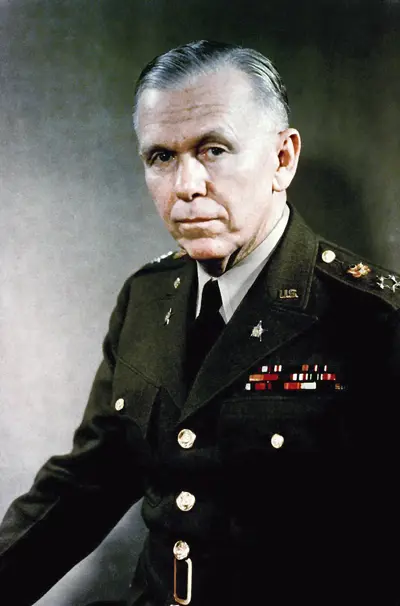
George Catlett Marshall Jr. was an American soldier and statesman. He rose through the United States Army to become Chief of Staff under presidents Franklin D. Roosevelt and Harry S. Truman, then served as Secretary of State and Secretary of Defense under Truman. Winston Churchill lauded Marshall as the "organizer of victory" for his leadership of the Allied victory in World War II. After the war, he spent a frustrating year trying and failing to avoid the impending civil war in China. As Secretary of State, Marshall advocated a U.S. economic and political commitment to post-war European recovery, including the Marshall Plan that bore his name. In recognition of this work, he was awarded the Nobel Peace Prize in 1953.
