Thomas Becket Quotes
I was called before the king's tribunal like a layman and was deserted in the quarter where I had looked for support. My brethren, the bishops, sided with the court and were ready to pronounce judgment against me.
Becket, Thomas. The Life and Letters of Thomas à Becket. Edited and translated by J. A. Giles, Whittaker and Co., 1846.


During the Nixon administration FBI director J. Edgar Hoover was requested by White House operatives to cooperate with "the Houston Plan" of illegal surveillance of many Americans. Hoover refused arguing that it was too risky.


The Massachusetts Bay Company


Kennedy hated Roosevelt who had forced him to resign as the U. S. Ambassador to England. Kennedy was an admirer of Mussolini and Hitler. He had allied himself with the part of the British aristocracy that was pro Fascist and opposed Winston Churchill and the democratic element in Britain. Kennedy had opposed aid to Britain to fight Hitler and advised all who would listen that Britain could and would not stand up to Germany. Roosevelt’s support of Britain with Lend Lease and other means proved Kennedy wrong pragmatically and Kennedy’s own statements had forever proved him wrong morally. Although Kennedy opposed our entry in WWII, his sons did not. His oldest son volunteered for a very dangerous mission and was killed. Kennedy blamed his death on Roosevelt {616651} and forever after slandered FDR whenever he got a chance until his son Jack got into politics when his ambition for his son outweighed his hatred.


This notice of Excommunication was promulgated to the Catholic clergy in Ireland in May of 1538. It required all Roman Catholic leaders to size the property of Protestants or Catholics who sympathized with them. Those who did were then regarded as traitors by the Protestant King. The anti-Protestant feeling culminated with the massacre of about 100 Protestants who were drowned in Bann a few years later.

Admiral Coligny was a leading French Protestant. He was murdered along with 50,000 Protestants by the French Catholics in what has come to be known as Massacre of Saint Bartholomew. Earlier in his career Pius V had been the an inquisitor or the Inquisition and was appointed “Inquisitor General For All Christendom,” so he had an anti-Protestant background. Incredibly enough, he was beatified and canonized a saint despite—some say because of—his participation in and encouragement murders of non-Catholics and even Catholics who happened to dissent on some aspect of theology. It is not clear whether the Pope knew in advance of the planned massacre or whether he or his representatives had any part in the planning of it. Since the end of the Second World War, Popes have been in the forefront of protest and moral condemnation of religious or ethnic atrocities, and it is hard for most of us to conceive that a Pope could countenance the murder of 50,000 souls by his faithful followers.

Kaltenbrunner was one of the major war criminals declared guilty at the Nuremberg Trials and hanged.

The Vatican & the Chinese Communist Government had been at odds for years with much of the Chinese church going underground. Fr. Jin had been jailed for a decade. Then the government allowed him and the Catholic Church and operate openly, but there were still Vatican conflicts over numerous issues including the right of the Government to approve senior appointments of church officials—a privilege the church claimed exclusively. The Vatican ordered Jin not to cooperate and especially not to reopen the national theological seminary which the government had ordered closed. There had been no training for Chinese priests and Jin wanted to reopen the national theological seminary but the Vatican refused cooperation waiting for the government to capitulate to the Vatican’s various demands. Fr. Jin defied the Vatican & reopened the seminary. Without officially admitting their failed tactics, the Vatican let the discipline issue against Jin drop & the national theological seminary thrived.


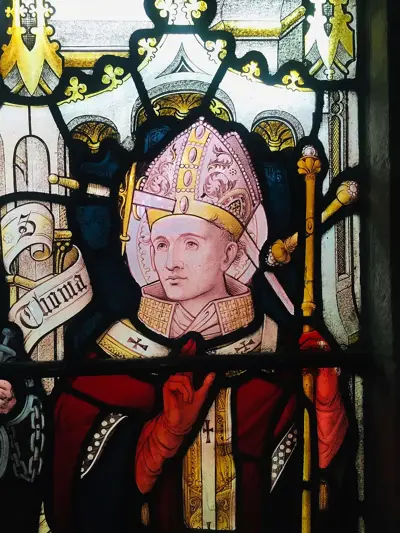
Thomas Becket (/ˈbɛkɪt/), also known as Saint Thomas of Canterbury, Thomas of London and later Thomas à Becket, was Archbishop of Canterbury from 1162 until his murder in 1170. He is venerated as a saint and martyr by both the Catholic Church and the Anglican Communion. He engaged in conflict with Henry II, King of England, over the rights and privileges of the Church and was murdered by followers of the king in Canterbury Cathedral. Soon after his death, he was canonised by Pope Alexander III.
