John Chrysostom Quotes
Nothing will divide the church so much as the love of power.
Chrysostom, John. "Homily 11 on Ephesians." Nicene and Post-Nicene Fathers, First Series, Vol. 13. Edited by Philip Schaff, Christian Literature Publishing Co., 1889, p. 106.


Curtis had at first arrested Samuel B. McPheeters a St. Louis preacher for pro-Southern sermons. Lincoln had countermanded the arrest order. Curtis released the pastor, but prohibited him from preaching in his own church. It took Lincoln many months to find this out and Lincoln then instructed this second instruction to Curtis not to continue the ban.

i.e., a clergyman representing a congregation The theory of this particular expulsion applied not to clergy in general, but to clergy who represented a Congregation. In the absence of strict separation of church and state, clergy representing congregations had representative and legal roles in other aspects of the government and therefore represented a problem of separation of powers within the government. The same logic, for example prohibited Sheriffs and Tax Officials from the House of Commons as well as Judges sitting in the Lords. With strict separation of church and state however, the separation of powers argument does not hold, and hence there is no such current prohibition. However, at the end of the 20th century, the Roman Catholic and some other religious institutions had reached the conclusion that clerics serving as elected representatives to various civil legislative bodies potentially had an inherent conflict of interest and divided loyalty and banned the practice from the religious end although the civil laws did not preclude it.


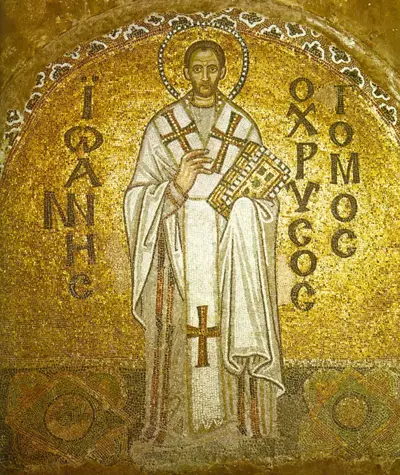
John Chrysostom (c. 347 – 14 September 407) was an important Early Church Father who served as archbishop of Constantinople. He is known for his preaching and public speaking, his denunciation of abuse of authority by both ecclesiastical and political leaders, his Divine Liturgy of Saint John Chrysostom, and his ascetic sensibilities. The epithet Χρυσόστομος (Chrysostomos, anglicized as Chrysostom) means "golden-mouthed" in Greek and denotes his celebrated eloquence.
