Walter Hussey Burgh Quotes
I never will support any Government in fraudulently concealing from the King the rights of his people.
Walter Hussey Burgh, 1742–1783, Irish statesman and judge, Member of Parliament, Chief Baron of the Irish Exchequer, Statement criticizing the then current government which did not stand up for the rights of the people
Sourced by: Eigen's Political and Historical Quotations

In 1628 Parliament, in response to abuses by King Charles I, was about to pass The Petition of Rights–-a type of Bill of Rights. The King gave assurances that the practices—such as forcing nobles to lend him money—would not continue and didn't want to be embarrassed by passage of a law which he claimed would indicate that the Parliament did not trust him and weaken the dignity of the monarchy. The Petition of Rights passed with Cole’s leadership.

This Cahier was the consensus of the Clergy of Blois in 1789. There were cahiers of several provinces of France—some by the clergy, some by the nobles. What is fascinating is the emergence of many of the pre-revolutionary French concepts. The example of the American revolution and its principles was known throughout the educated classes of France.

The speech was never actually delivered, but instead the Bishop published it. It received wide distribution including in America where it was published by the Maryland Gazette on September 29, 1774.

For Turgot, see below
_0_thumbnail_47x47.jpg "Statue of Robert Hall in Leicester.")
For many people the implication of this quotation is that there should be no government secrets withheld from the citizens who have the right to examine. Others argue that government may have temporary secrets to protect against foreign enemies for example, but that these must be declassified very promptly so that the citizens can examine the actions of their government in time to replace the government if they are not satisfied. Almost all government officials tend to reject the first implication out of hand, and grudgingly accept the second with their discretion controlling when declassification should take place. The problem of America is twofold. There is much over-classification (material kept secret that should not be at all), and the time till declassification is long in general and truly absurd in many cases. For example, there are documents from WWII that by 2013 had still not been declassified. See {591444}, {641317}, and {589105} for exemplar views. William Jennings Bryan introduced this principle into the American political dialogue. See {641027}.
While he thought a people had a right to have a king, he also made radical statements regarding the British and their monarchy. See {633999}. The right of a people to have a king was also stated by the President of Harvard in that period— {633996}.


This was a dramatic assertion at the time, even for England with it’s Magna Carta.


This was written shortly before he assumed the crown.

Originally it was published in Boston under the name “A Columbian Patriot.” The “principles to which she referred were the principles set out in our Constitution of 1787.

Prior to Cooke’s indictment of English King Charles I, there was a concept of Royal Impunity—that a sovereign could not legally be called to account for his actions as ruler of the state. The concept of “sovereign immunity” was a concept where the sovereign and his agents could be given immunity for specific actions, but they never would have impunity again where there were no limits to the crimes they might commit against their own people. Charles I refused to even recognize Cooke’s indictment and so have heads of state called to account for their major crimes since then all the way down to Saddam Hussein in 2006 who made the same argument. Cooke was himself hanged, drawn and quartered almost 20 years after the Charles I trial for his part in the “Regicide” so the concept of Royal Impunity did not die quickly.


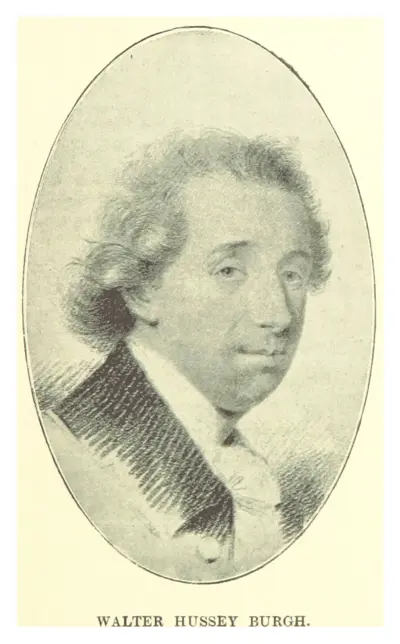
Walter Hussey Burgh (1742 – 1783) was an Irish statesman, barrister and judge; he sat in the Irish House of Commons, and was considered to be one of the outstanding Irish orators of his time. He served briefly as Chief Baron of the Exchequer in the last year of his life.
