Jonathan Shipley Quotes
The Crown can have no rights inconsistent with the happiness of the people.
The speech was never actually delivered, but instead the Bishop published it. It received wide distribution including in America where it was published by the Maryland Gazette on September 29, 1774.
Jonathan Shipley, 1714-1788, English Protestant Bishop, Member of the House of Lords, Speech Prepared for Delivery in the House of Lords, 1774
Sourced by: Eigen's Political and Historical Quotations
_0_thumbnail_47x47.jpg "Statue of Robert Hall in Leicester.")
For many people the implication of this quotation is that there should be no government secrets withheld from the citizens who have the right to examine. Others argue that government may have temporary secrets to protect against foreign enemies for example, but that these must be declassified very promptly so that the citizens can examine the actions of their government in time to replace the government if they are not satisfied. Almost all government officials tend to reject the first implication out of hand, and grudgingly accept the second with their discretion controlling when declassification should take place. The problem of America is twofold. There is much over-classification (material kept secret that should not be at all), and the time till declassification is long in general and truly absurd in many cases. For example, there are documents from WWII that by 2013 had still not been declassified. See {591444}, {641317}, and {589105} for exemplar views. William Jennings Bryan introduced this principle into the American political dialogue. See {641027}.


See Edmund Burke and Franklin Delano Roosevelt for a similar view.
See Charles James Fox, John Milton, Jeremy Bentham, George Mason, Henry Clay, Benjamin Disraeli and Woodrow Wilson for similar expressions of this idea.


See Charles James Fox, John Milton, Jeremy Bentham, Grover Cleveland, Henry Clay, Benjamin Disraeli and Woodrow Wilson for similar expressions of this idea.


There is a certain redundancy in that “Fenian” means “Party.”

“Magistrates” at the time were rulers and heads of government and state. There was little or no separation of powers and the chief magistrate could make edicts and laws, enforce them and be the judge and jury as well. In the United States, the President is also called the “Chief Magistrate” even though his powers are only within the Executive Branch. For us today, “Magistrate” usually refers to a judge or other official of the Judicial Branch.
While he thought a people had a right to have a king, he also made radical statements regarding the British and their monarchy. See {633999}. The right of a people to have a king was also stated by the President of Harvard in that period— {633996}.


For that, the Church burned him at the stake. Note the phraseology and compare it to Gettysburg Address {458852}. It is not known whether Lincoln was aware of this quotation or others that used similar wording.

The statement so offended the Lords—the highest court of England—that he was imprisoned by the Lords and not released until he had recanted the position. The argument goes on today in many countries incuding the United States.
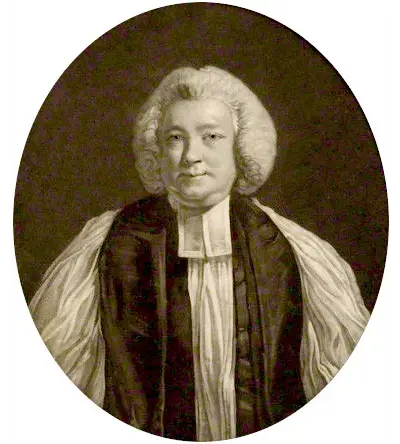
Jonathan Shipley was a clergyman who held offices in the Church of England (including Dean of Winchester from 1760 to 1769), who became Bishop of Llandaff from January to September 1769 and Bishop of St Asaph from September 1769 until his death.
