George Washington Quotes
I have tried every Method I Could think of to procure Arms for our Men, they really are not to be had in these Governments.
This quotation is noteworthy for two reasons. First, it shows the ineptness of the Continental Congress and the tendency not to want to spend money on the military even in a crisis. America really did not enthusiastically appropriate money for military until WWII and since then, military spending has dominated the American Federal budget. The second reason is that it shows the myth that Colonial America was full of men each armed with their gun and Americans were expert at using them. Most of the men joining Washington’s Army did not own a gun and had little or no skill with guns. See {613056}. Early America was not a gun culture. Guns were expensive, needed maintenance, took too long to reload, and were not as effective for most purposes as other weapons like hatchets and knives. American Colonial war was mostly hand to hand combat with relatively little shooting.
George Washington, 1732-1799, 1st President of the United States (VA), Letter to John Hancock, Early 1776
Sourced by: Eigen's Political and Historical Quotations

Washington was very unhappy with militia even from his native Virginia. See also {613030} This quotation is very important because the common belief is that all Americans in Colonial America were skilled with a gun and that there was a strong gun ownership culture. Many people quote {613057}. However, that was not the case as this and other research has shown. Less than one quarter of the Virginia militia had any weapon. Guns were expensive and only a minority of Americans could afford them. Despite the image of sharpshooters, and there were some, most guns were very inaccurate in the hands of most men.

For most of the history of the United States – especially in the governments of our Founding Fathers, there was an extreme antithesis to defense spending and military preparedness a fact that conservatives who look to the Founding Fathers as models and legal precedents for everything that we do today generally do not realize as they lobby for defense spending. The change really took place after Pearl Harbor and WWII where America was totally unprepared for war.

While the militia had very few arms, Van Rensselaer had no military training and commanded a critical army because of his political connections—common at the time. After he botched the Battle of Queenston Heights he returned to politics but his military failure dogged him for the rest of his career. The quotation is yet another that illustrated the myth of all Americans armed and ready to fight for the nation. There was no gun culture then, and guns were expensive and a minority of Americans owned them. In this case less than 20 percent of the American militia owned a gun. And Congress would just not at the time spend the money for weapons.

The Factory had been established by the State of Virginia in 1775 to make guns. America filled with armed Americans in the Colonial era was a myth. Early America was not a gun culture. Guns were expensive, needed maintenance, took too long to reload, and were not as effective for most purposes as other weapons like hatchets and knives. American Colonial war was mostly hand to hand combat with relatively little shooting. Less than one fourth of the men joining Washington’s army owned guns. Gun factories could not survive for want of customers and gunsmiths went into other occupations. See {613052}. With the rebellion, it was critical to manufacture guns to arm the soldiers who had not their own. But the efforts like this were relatively feeble. The factory director who made not a single gun in over a year was then promoted to Commissary General of Munitions in the Continental Army. He was married to George Washington’s sister. He did however finance much of the munitions he procured with his own personal funds so made up in wealth and patriotism what he lacked in manufacturing skill.

In the early 18th century, things were very unsettled between Scotland & England with the succession of both countries in question. The result was the famous union of the two countries in 1707. At the time the Scottish Parliament wanted to intimidate the English as well as to be able to fend off English troops if things did not go well. The clause has much contemporary importance because it shows what a nation would do that wanted every man armed against powers which might restrict their freedom. The American Founding Fathers at the Constitutional Convention knew about this law. They even adopted other ideas from this law--{615975}. If the Founders had wanted every man armed as some modern gun control opponents maintain, they were brilliant drafters and would doubtless have written something like this. It supports the view that what was intended was not an armed nation but a nation where the states could organize “well ordered militias” and the Second Amendment resulted.

There were military procurement problems in almost every war in which the United States has been engaged.


She advocated armed self-defense for Blacks.


It would be more than a decade before the phrase “well regulated militia” would be added into the Constitution as the 2nd Amendment of the Bill of Rights. This resolution was the last of several passed at this meeting by which Maryland endorsed resistance to the British. So these resolations would have been widely distributed throughout the colonies and known by the leaders. In 1788 Alexander Hamilton Published Federalist 29 which also used the phrase. (See {588393}.) Then on September 25, 1789, the Congress proposed the Bill of Rights and the 2nd Amendment using the same key phrase, “well regulated militia.” Whether the drafters of the 2nd Amendment got the phrase from Hamilton’s Federalist 29 or from the Maryland Resolutions is not known but Hamilton’s was much more current. Did he get the phrase from Maryland? Did Congress get it from him? Did Maryland originate the phrase or was there an earlier use that influenced the Maryland drafters? At this point no one is sure, but the phrase is critical to the meaning of the 2nd Amendment because the Supreme Court has repeatedly held that the Second Amandment does not apply to individuals but only to the State’s right to bear arms within the “well regulated militia” and not as individual citizens. The right is that of the State government and that is why a state can control guns including banning them if they choose. So an individual in America does not have the constitutional right to bear arms. He may have a state constitutional right but in other states he may not use a gun in certain places and may not possess certain types of guns like hand guns which are illegal in New York, Washington DC and some other places.


There is a , romantic American myth about the Militiamen in Colonial and Revolutionary America—the citizen soldiers who would leave their farms and rise to the military necessity of the day. However, not only were the militia very hard to muster to duty, but most actually didn’t own or have experience with firearms, and the prevailing opinion of knowledgeable military leaders from George Washington on down was that the militia were not very good soldiers. See {613015}, {613016}, {613022}, {613027}, {621987}, {621988}, {613030}, {613033}, & {613056}


With martial law came the authority to seize ALL guns in the colony for the emergency. This was not to disarm the general populace. It reflected the fact that there were relatively few colonists who owned guns as they were very expensive. The Governor could take those that existed and use them to defend against the rebels or whatever. There were more gun owners in the Revolution but still a minority. Even after the War of 1812 only 30% of Americans were armed, and that shortly decreased to 10% as there was no real culture of gun ownership in early America. This would come around the Civil War.

This is historically a very important quotation. It shows that gun control was existant in Colonial America. The violation of the gun laws were so serious that the Connecticut Council itself heard and tried the case and it was not even handled by the constable. On the same day, they also fined Bartholomew Barnardt for allowing his son to shoot a militia musket in his possession. Today, most states would not be allowed much gun control as politically there is a belief that in Colonial America gun use and ownership was almost universal. That assertion appears to be untrue. See {613056} and {613057}.

This quotation is very controversial among historians. Beverly was in a sense the first American historian, although he had no formal training. His extolling the military and sharpshooting virtues of his fellows may or may not have been an exaggeration both as to their skill with firearms and their ability as soldiers. There is much evidence that only a minority of the people of Virginia possessed firearms at the time yet Beverly’s image is the one that has come down to us in the romanticized view of early America. Even fellow Virginian, George Washington {613056} complained that his Virginia civilians made poor soldiers compared with “regulars” who had been trained to shoot, and when Virginia militia reported for duty less than one quarter had firearms which were very expensive and not very accurate at the time.
This is yet another quotation demonstrating that the image of early America as a gun culture where most men were armed, skilled with those arms, and ready to come to the defense of the country. It turns out that none of the three corresponded to any historical reality for most Americans.
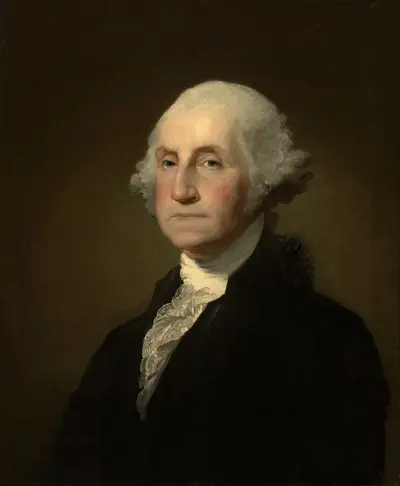
- Born: February 22, 1732
- Died: December 14, 1799
- Nationality: American
- Profession: President
George Washington was the first President of the United States (1789-97), the Commander-in-Chief of the Continental Army during the American Revolutionary War, and one of the Founding Fathers of the United States. He presided over the convention that drafted the current United States Constitution and during his lifetime was called the "father of his country".
